Showing posts with label Republic of Georgia travels. Show all posts

Monday, March 21, 2011

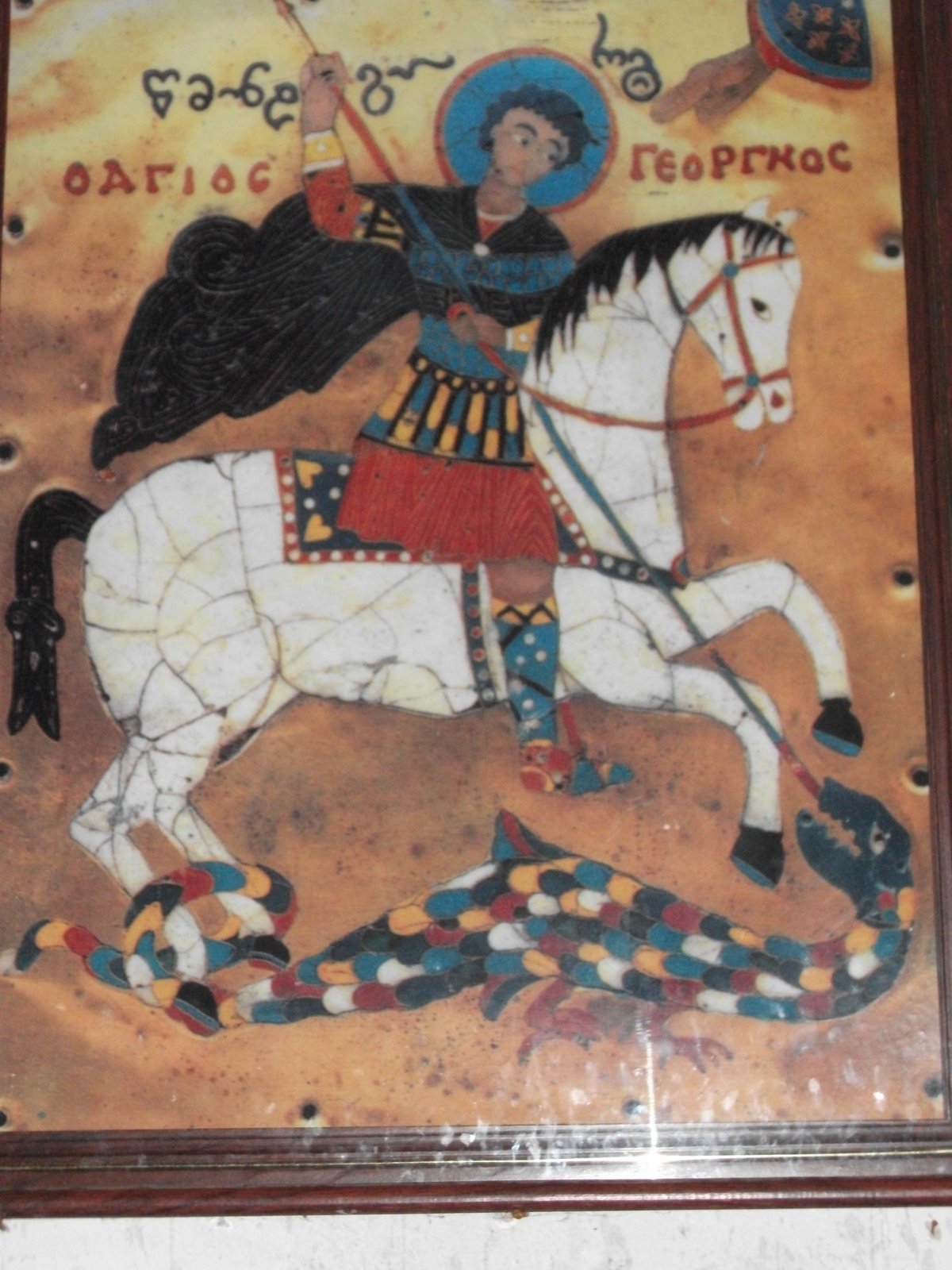
Saint Nino, Saint George and the Dragon.

Literally every church in Georgia has paintings and or statures of two venerated saints. They seem to be as Georgian as the bad driving. To understand why, you have to know a little about Georgian history.

St. Nino, converted Georgia to Christianity in 347 AD:


Then there is St. George, the patron saint of Georgia, from which Georgia derives its name.

 
Posted by Picasa

Every church and even the statue at the center of Tbilisi's Freedom Square, celebrates St. George. No one is exactly sure if there really was a St. George because the myths about his origins as a powerful figure who protects earthly domains and controls the forces of nature predate Christianity. Those forces (which by the way are often referred to as mother earth) are represented by the green dragon with which St. George is usually portrayed. Stories of St. George are more ancient than our written language, dating to the Summerian civilization 5,000 years ago. Never mind. Georgian's don't care.

Note that the letters “GE”: repeat twice in the name “George”. There's a reason for that. The ancient meaning of “GE” is that which pertains to the earth. That's why you see these letters used in modern words like geography, and geophysics. Now remember that creation myth that Georgians love to tell visitors to their country about? The one about how God saved this special place for himself and ended up giving it to the Georgians? You begin to understand how Georgians feel about their land, their place on this earth and why they like their name!

So if St. George pre-dates Christianity, how did Christianity arrive?


A woman named St Nino (sometimes called St. Nune), converted Georgia to Christianity, arriving from the Roman province of Cappadocia in what is now central south Turkey in 347 AD. In Christian myth, she is reported to have been a relative of Saint George, as well related to the Patriarch of Jerusalem. Known as the “enlightener,” she was both a healer and a healer who preached the Gospel. Notice the droop of her cross? There's a reason for that. Apparently she grabbed the first thing at hand to form a cross and in Georgia, vineyard that it it is, that would be grape vines. Every since that time, you can tell an icon painting from Georgia by the tell-tale shape of the cross.

In a time before England and the Britons were Christian, St. Nino crossed Turkey to what was then called Iberia (today's Armenia and Georgia) and spread the gospel first to Armenia and then into modern-day Georgia. Not a shabby undertaking today, let alone in her day. And we had been standing at the very spot in the cathedral of Svetitskhoveli where she made her first convert and in front of her glass and golden tomb.

After that dive into history, we were hungry......

Thursday, February 24, 2011

Some Doors You Enter for Everyone

A friend called me the other day. “For Pete's sake,” he said. “How long are you going to leave us at the door of the cathedral?”

I was sheepish. “I've been busy. You know... marketing work. My book. I'm being workshopped at Lighthouse Writers Workshop. Revisions....page goals.....gee, you mean people are really paying attention?”

He assured me, people are. ”Well, life got complicated,” I told him apologetically.”Sometimes it feels as if adventure is far away from me. Must have been another person who was there. Not me”

“You made that trip for all of us,” he said. ”Write!”

So again...I am there.


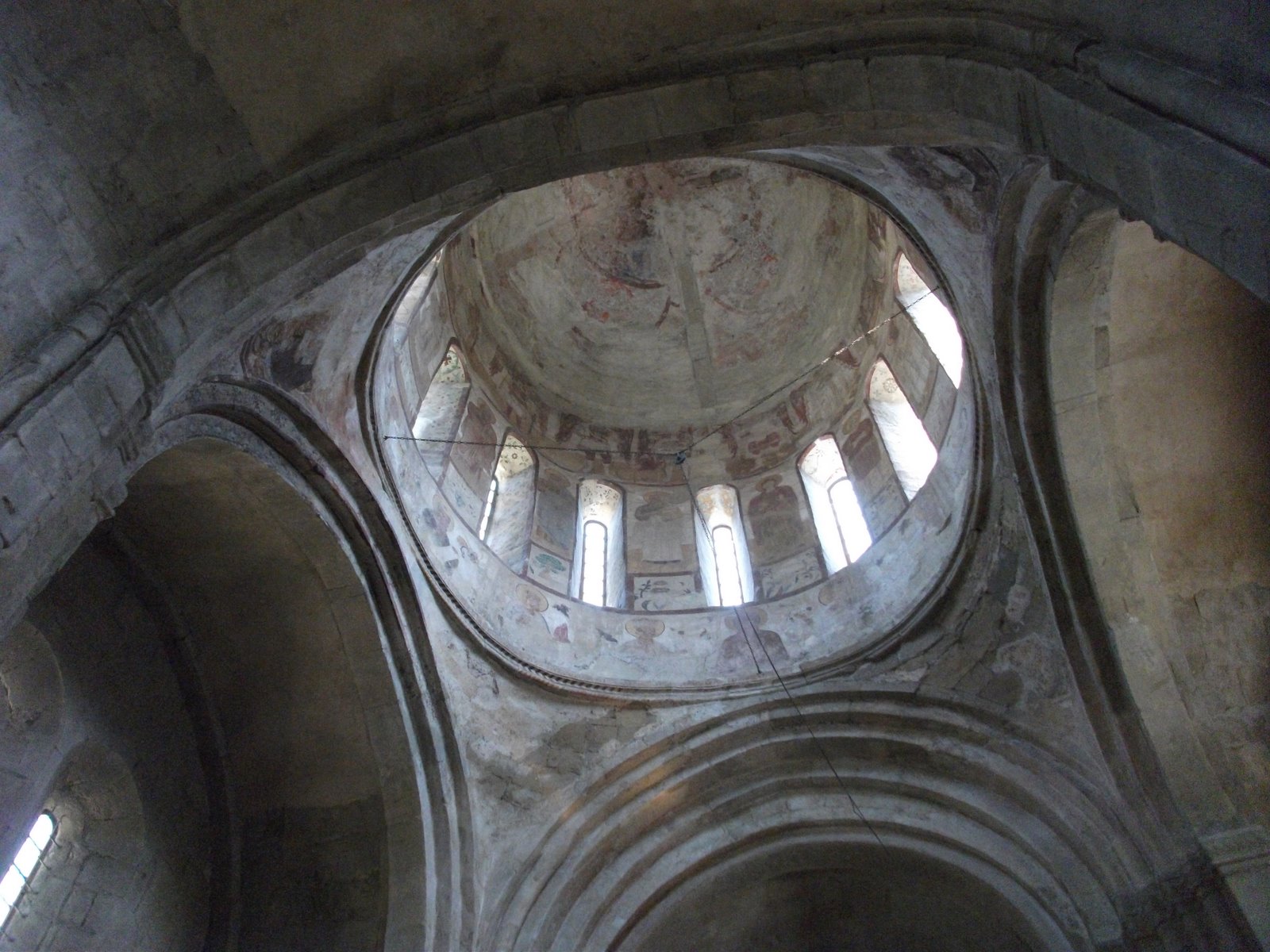
Inside its impressive walls, I done a scarf and we cross the sweltering plaza, enter the massive doors and find ourselves in a towering space, cool; shadowy and mysterious.

Candles flicker, the smell of burning incense is strong. Brass and gold shine below walls of enormous frescoes.
 
Women swathed in scarves and huge aprons bend nearly double over hand-cobbled brush brooms, a continuous sweeping, sweeping, sweeping that did not stop while we were there. I find myself wondering if they might not be the prototype for the Soviet BabaYaga, the witch with the broom and the house that turns on chicken legs.
 
Inside the massive space sits another stone cathedral,
 

perfect in proportion and detail, a miniature of the great cathedral that encases it. It is the site, where in 327 the first convert, Georgian Queen Nana, converted to Christianity.
 
Posted by Picasa

Near it, the iconic glass and gold tomb of the Queen herself. I take pictures and again get in trouble – an old man in hat, boots and slavic-looking belted shirt, praying at the miniature cathedral believes that I have taken his picture. I haven't, but back off out of respect.
 
Posted by Picasa
Svetitskhoveli is our introduction to the history of Georgia. Here we learned the connection between St Nino and Saint George and the Dragon....

Tuesday, October 5, 2010

The Georgian Truth: Life is short – celebrate!

There are days that seem to slow down, whose meaning is apparent, when the value of this short life is measured as priceless.


Posted by Picasa

Between the heat and my jet lag, I loose track of whether this is one of them or not and only later discover the truth; that all experiences enrich one, if your soul allows access.


The day's un-relenting heat and humidity makes the air shimmer. We are off the main road, following the fence lines deep in Kakheti and our pace is nearly sane. The grape vineyards appear lush. Taking in their endless reach toward the towering Caucasus in the distance, I recall hearing stories of this land's creation.


Georgian's have lived in their land for millennia. Cities like Batumi, along the Black Sea, were occupied long before the Greeks and Romans named the settlements. Georgians have two stories about how they came to live in the land that they call the most beautiful place on earth. Both are intimately tied with the bounty of the land and the unique spirit of this people.

The first story is completely in Georgian character: It seems that while God was busy assigning countries to the peoples of the world, everyone else showed up to get their assignments. Not the Georgians. While this was going on, they were busy having a party. Food and wine were flowing. Joyous dancing and song celebrated life and love. Toast after toast was made and, you guessed it, the Georgians missed their assignment. God finished His work and saved the best land of all for Himself; the bounteous land of Georgia. There, He discovered the Georgians, feasting and celebrating life and toasting God for the abundance they had received; unconcerned about possessing what they saw as God's creation. God was pleased that they recognized the source of the bounty and rewarded them with the garden that He had saved for himself.

Another version says that God was assigning the bounty of the world to the people in it and tripped over the Caucasus mountains, spilling into the lush garden land of Georgia all good and growing things. Seeing that the people cared for it well, he gave the land to the Georgians.

Take your pick.

The Turks, the Tartars, the Mongols, the Nazis and the Russians, among others, haven't always agreed with God. Over the centuries no less than forty invasions and protectorates have tromped over and through this land.

As we approach our next destination, the Alaverdi cathedral on the plains of Kakheti, the humidity actually blurs the lines of the cathedral walls marching off in either direction. The snow-covered peaks of the Caucasus appear to rise directly out of the sweltering valley floor, climbing to astonishing heights in surreal back-drop. Hand tools, of the the hand-hewn wood, museum-quality, stand in a row inside the arched and fortified gate. They have been recently used.
 
Posted by Picasa

We descend the broken steps to the courtyard containing a pampered cathedral vineyard and confront a magnificently-proportioned, classic cathedral surrounding by scaffolding. Proud, ravaged by time and battered by earthquakes, it used to be the largest cathedral in Georgia until the new national cathedral opened in Tbilisi. We stoop to enter a low side door, after discovering that the enormous entrance doors are shrouded in scaffolding.
 
Posted by Picasa


Upon entering, I get into immediate trouble when I pause to snap a photo. A young,black-robed priest rushes toward me waving his hands, I cannot understand a word, but his meaning is unmistakable. No pictures allowed. I clutch my new digital camera tighter in my hand. If he tries to take it away from me, he is going to end up in a wrestling match!


The ancient frescoes are faint and fractured and in many places, crudely plastered over. Strangely-twisting floor candle holders stand about, most lit. As remote as we are, there are other pilgrims moving about the dim and dusty place, which has clearly seen better days. Here, more so than in the better-preserved churches of Tbilisi, I sense the ancient times and the great faith and fortitude of this people and land.


The cathedral is the far point of our day's destination. Nic fortifies Jeff and Heather with a care package of American comfort food (much of which had arrived in the one bag of ours that actually arrived with us!) before dropping them off and head back north west on The Grape Trail, where more adventures await us.....

Thursday, September 30, 2010

Along the Grape Road in Kakheti....

The road we are traveling isn't just Marco Polo's historic trade route, although the thought that it is, adds some historic dignity to our madly careening pace. This ancient road is also known as “The Grape Trail.” The Kakheti Region is the center of the wine producing area of Georgia and across the former Soviet Union, Georgia is synonymous with wine.

Unlike Russia, it's neighbor to the north and east, where vodka is the national drink, Georgians love their wine. In fact, the official Kakheti website actually proclaims that every Kakheti family has their own family vineyard. I'm not kidding! The vineyards here have been in production for a few thousand years, Nic tells us. It has been said that the spirit of the Georgian feast resides in its wine (“glvino,” from which descends our modern word “wine”). Just as in Italy, which will be our next country, most vineyards are family plots. Every family makes its own wines here, just as every family has its own pigs for its own bacon, a cow or two to make it's own version of the distinctive, salty Georgian cheese, it's own orchards....Self-sufficient, these people.

Oddly, the vineyards through which we travel appear interspersed with corn fields. It's true, even here, that corn and it's not-all-together-healthy by-products, has become the ubiquitous crop of the world, and is beginning to compete for space with other crops. I find myself rooting for the grape vines and I cannot wait to taste the wine about which I have heard so much!

Sill traveling at breakneck speed, we come out of the deep ravine into the fertile Alazani river plains, having left behind the land with its slow, painfully-pumping oil wells. (which reminded us of the drive between Denver and Longmont, Colorado!) This is a land where vineyards come up to the edges of the road, so close that we can see enormous clusters of grapes hanging heavy on the vines, even at our hysterical speeds. Crumbling, ancient fortresses stand sentinel atop the many distant bluffs. In the distance rise the snow-capped peaks of the Caucasus. Telavi, where we are headed, is the capitol of the wine region and the site of the ancient fortress of the principality of King Irakli II.

Our speeding carriage begins to climb, weaving in and around hay carts and ancient, sputtering trucks loaded with produce. Through tiny village after village, on into the hills above the valley floor we climb. Some are shadowed by sentinel fortresses above them, others still circled by their own rampart remains, reminders of the need for protection from invaders from all sides. For Georgia has had need of protection through the long centuries.

Our pace finally slows as we reach the high point of the plain – the hill city of Telavi. Into the ancient streets we dive, curving around and through the city center, upwards to the castle fortress. We come to a sharp curve and crane our necks looking upwards at the enormous bronze of King Irakli, himself, astride his war horse, then abruptly swing into the parking lot next to the fortress walls, which house castle, chapel, museum and art gallery. Much of the structure dates from the 11-12th centuries, a time when Georgia, like Italy, was divided and ruled by feudal kingdoms. King Irakli presided over what is called “The Golden Era” when Georgia was at its zenith of self-rule.
 
Posted by Picasa

Inside the wall gates, we stroll through the castle vineyard, pay our fee and begin with the castle, coming face to face with the far east. It is an odd mix of European vaulted and domed-ceilings, combined with Persian, almost Turkish, influence in the key-hole doorways and windows and many wide, covered open-air rooms surrounding the central areas.

 
Posted by Picasa

The hall ceilings are low (To put it politely, the king was both height-challenged and vain) so passageways and the throne room were designed to make him look taller – the throne room has a dais that placed him above anyone else who entered it.

 
Posted by Picasa

Strolling past the ruined chapels, we climb to a pergola walk-way with a spectacular view over the entire valley floor to the distant Caucasus peaks. One could imagine twilight hours here with his royal courtesans. Surely the king could spot his enemies coming at a great distance. We catch a breeze and pause, aware that the possibility that the next buildings are air conditioned is remote.

We are right. On that steamy day the art gallery is stifling and dark, containing mediocre European and surprisingly skillful Georgian oil paintings. The museum is cooler and just as dark, full of the requisite ancient armor, even more ancient tools and clay dining utensils, including ancient “chapi,” the two-handled jugs with short necks and bulbous bodies in which Georgian wine has been stored and served for thousands of years. If this sounds biblical, I think they are!

We cool our heels in the rustling shade trees while taking turns at the WCs, which are nothing more than rooms with a hole in the floor and no paper. Jeff and Heather, a Peace Corps couple assigned to the region, join us for the second part of our day. Before leaving Telavi, our driver, with greater care than any he has shown that day, drives us to the great plane tree that graces the center of town. It is over 800 years old, an enormous, long-suffering giant that has withstood invasions, crumbling kingdoms and seemingly, time itself. Plane trees are a symbol of eternal life in Georgia – lore has it that plane trees were THE trees of the garden of Eden. If so, then the tree plays a role in the stories we hear later that day.

We descend again to the valley floor and travel deeper into the countryside...

Tuesday, August 31, 2010

Circadian Rhythms and the Meeting of the Continents.

We were moving easterly, on the old European trade route (the one that Marco Polo and his uncles traveled to reach the far east of Persia, India and China) heading toward the border with Azerbaidzhan and Russia when I finally clicked into the right time zone. Ten hours eastward is one big flippin' leap for the internal clock to make. I had faked it pretty well the day before, with only a few hours of sleep after our middle-of-the-night arrival and a short nap in late afternoon. But finally, I was consolidated all in one place – the Kekheti Region of the Republic of Georgia – and one racing vehicle -- a substantial sport utility vehicle being driven by a crazy Georgian driver.

The moment I opened my eyes and made the transition coincided with our driver's particularly aggressive “bully pass” as he barreled up behind a smaller, slower-moving (translation, more sanely-paced) car, riding his bumper until the car edged, just slightly, to the right. Pulling to the middle of the road straddling the line, we began to pass, while meeting an oncoming truck that edged (barely) to his right. I swear, the door handles of all three cars mingled metals! I closed my eyes again and prayed; repeatedly, during that trip, as it turned out. Now that I am a veteran of the Georgian roads, I can tell you – most of them drive like our driver. (Which, coincidentally is exactly how they drive in Russia too!)

Lest you think that my blog sounds like a fiction story, I must confess that I've taken a vacation. Of weeks, countries, and continents. The adventure spanned two and a half continents, at least. I say “at least” because the Republic of Georgia sits on the Black Sea at the juncture of Europe, Asia and the Middle East. Armenia, to its south claim to be in Europe. Turkey, to its southwest claims middle eastern heritage. Azerbaidzhan professes Asian influence but won't commit and Russia, to the northeast is, well – Russia! Thus the half-of-something thing.

The weeks were hectic leading up to the adventure to visit Nic and Sora, there due to his Fulbright in Tbilisi, Georgia. We knew they would take care of us there. It was for the rest of the adventure we needed the extra flight reservations and train passes and hotel reservations and car rentals and international driver's licenses and road maps and Euro exchange. We trekked through five airports to reach Tbilisi, arriving in the middle of the night to an airport packed with people. That is, we arrived, our checked bags did not. They could not keep up with a travel itinerary through four countries and five airlines (three of them contracted to the two major carriers) in the space of 28 hours.

So our adventure began with the clothes on our backs and a son, grinning ear-to-ear, allowed into the baggage claim/customs area to help us fill out (in Russian) the lost-bag forms for our bags. In the process he spotted his bags, lost when he returned from his Washington DC meetings the week prior, resting five feet from my toes – one of them our daughter's distinctive, Cherry Creek High School swim team bag!

First I clicked into the timezone, then accepted that the international data and voice setup for my Blackberry were not going to cooperate. Other than an hour or so that week, I was cut off from world news, social networks, blogs, email and other time-consuming 21st century lifelines. It was me, my digital camera and my notebook capturing this experience. The brownouts so often experienced in Georgia on steaming summer days further made us appreciate when there was electricity at all. Nic had been right. Yes, we had lived overseas in Germany, and yes, when we lived there it was still, in many ways, an “occupied country.” But it had not been, even then, the adventure that they are having.

So, once again, my note books are full, I am determined to conquer my photo phobia to get some visuals up on my blog(or FaceBook)from the trip, and this is the first of many blogs about the adventures we have had!