The ancient Celtics had a saying: “When God made time, he made plenty of it.”
That thought probably has no place in a blog that months ago was supposed to get you to a Georgian table, into old Tbilisi, and off to our adventure in Italy. But strangely, it has everything to do with this post. While none of us can know the time we will be given, the strange elasticity of this past year has made me more forgiving of the time necessary to process news and changes, griefs and joys. I believe it is possible for we humans, when we back off the hyper-speed pace of our lives, to rediscover a more human dimension to time; the meaning of which most Twitter and blog posters, intent upon filling every space in time with words, words, words, probably miss entirely. For me, time has meaning. Time serves a purpose, if sometimes only to teach us endurance and that what comes before and what follows is connected only by this moment. A full year has gone by since we departed for Europe and parts east of there, and the memories of the moments there, in that strange yet familiar land, are as fresh in my mind today as they were as they occurred.
So too, are the memories of a sweet family day for our family; our son Nic's wedding to Sora two years ago today.
It was a beautiful, perfect day and time neither makes it more or less wonderful (although the family now can tell stories about some of the mishaps that occurred prior to the ceremony – much of it to me. Let it not be said that I am missing a sense of humor.) Since we don't have the new address for the couple, this will have to suffice as an anniversary card!
I write this as an homage to what the two of them have become together; complete, strong, and as of last night, I hope, finally reunited in Washington DC. Nic has begun graduate school at the Johns Hopkins SAIS school (http://www.sais-jhu.edu/index.html) and Sora will spend several weeks with him before departing for her own graduate studies at Cambridge. It is not at all the way many of we baby boomers began our married lives, but it is entirely them.
Some day in time they may look back at this stage and know how much love and support surrounded them as they continue their adventure. I, for my part, wish that I had as much courage...or smarts for that matter!
For today, I remember the anniversary of their day, and our visit to them last year. And I swear, I'll get you to that Georgian feast I promised...just remember, “When God made time, he made plenty of it.”
Monday, August 8, 2011
Monday, March 21, 2011
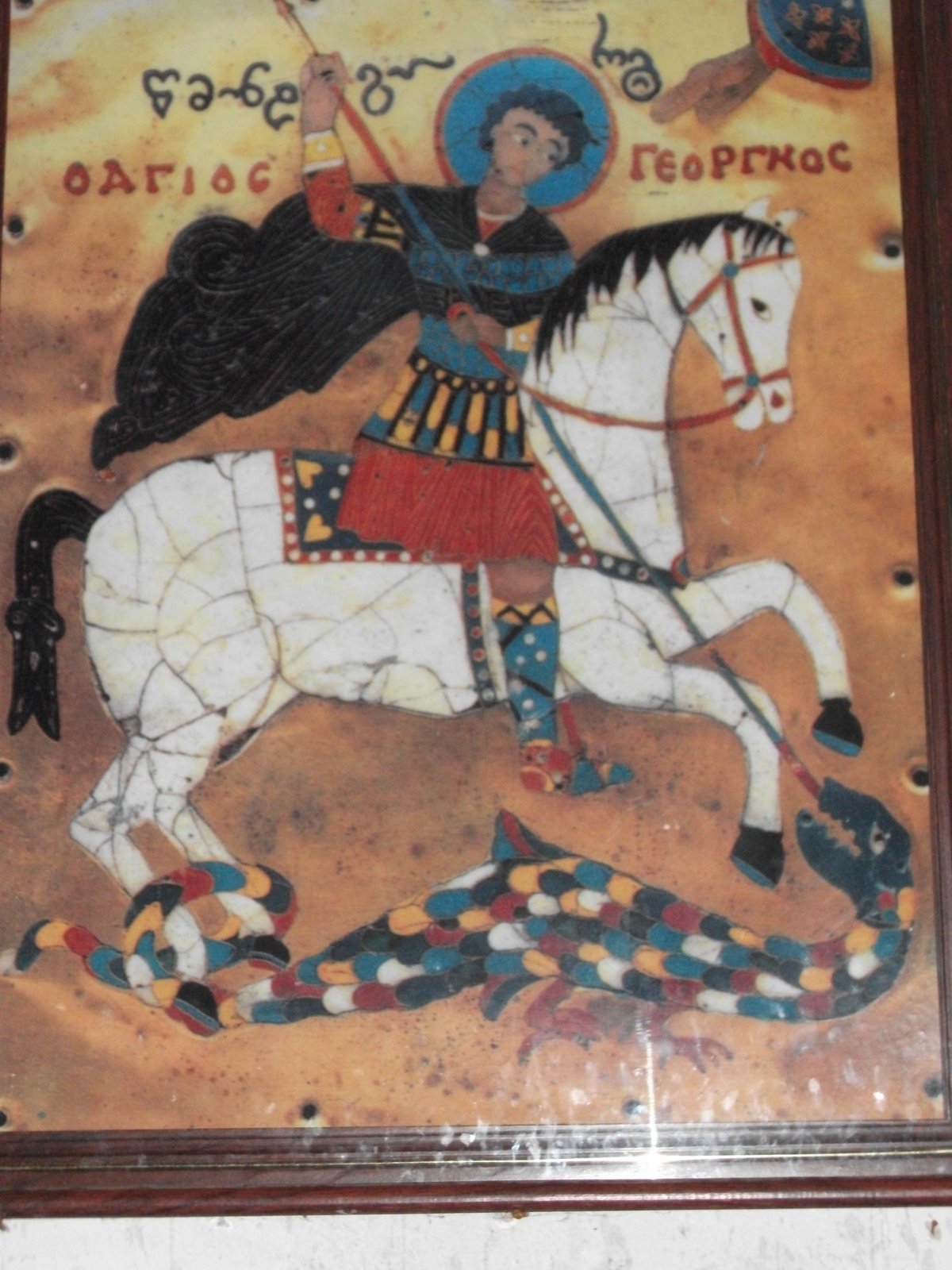
Saint Nino, Saint George and the Dragon.
Literally every church in Georgia has paintings and or statures of two venerated saints. They seem to be as Georgian as the bad driving. To understand why, you have to know a little about Georgian history.
St. Nino, converted Georgia to Christianity in 347 AD:
Then there is St. George, the patron saint of Georgia, from which Georgia derives its name.
Every church and even the statue at the center of Tbilisi's Freedom Square, celebrates St. George. No one is exactly sure if there really was a St. George because the myths about his origins as a powerful figure who protects earthly domains and controls the forces of nature predate Christianity. Those forces (which by the way are often referred to as mother earth) are represented by the green dragon with which St. George is usually portrayed. Stories of St. George are more ancient than our written language, dating to the Summerian civilization 5,000 years ago. Never mind. Georgian's don't care.
Note that the letters “GE”: repeat twice in the name “George”. There's a reason for that. The ancient meaning of “GE” is that which pertains to the earth. That's why you see these letters used in modern words like geography, and geophysics. Now remember that creation myth that Georgians love to tell visitors to their country about? The one about how God saved this special place for himself and ended up giving it to the Georgians? You begin to understand how Georgians feel about their land, their place on this earth and why they like their name!
So if St. George pre-dates Christianity, how did Christianity arrive?
A woman named St Nino (sometimes called St. Nune), converted Georgia to Christianity, arriving from the Roman province of Cappadocia in what is now central south Turkey in 347 AD. In Christian myth, she is reported to have been a relative of Saint George, as well related to the Patriarch of Jerusalem. Known as the “enlightener,” she was both a healer and a healer who preached the Gospel. Notice the droop of her cross? There's a reason for that. Apparently she grabbed the first thing at hand to form a cross and in Georgia, vineyard that it it is, that would be grape vines. Every since that time, you can tell an icon painting from Georgia by the tell-tale shape of the cross.
In a time before England and the Britons were Christian, St. Nino crossed Turkey to what was then called Iberia (today's Armenia and Georgia) and spread the gospel first to Armenia and then into modern-day Georgia. Not a shabby undertaking today, let alone in her day. And we had been standing at the very spot in the cathedral of Svetitskhoveli where she made her first convert and in front of her glass and golden tomb.
After that dive into history, we were hungry......
St. Nino, converted Georgia to Christianity in 347 AD:
Then there is St. George, the patron saint of Georgia, from which Georgia derives its name.
Every church and even the statue at the center of Tbilisi's Freedom Square, celebrates St. George. No one is exactly sure if there really was a St. George because the myths about his origins as a powerful figure who protects earthly domains and controls the forces of nature predate Christianity. Those forces (which by the way are often referred to as mother earth) are represented by the green dragon with which St. George is usually portrayed. Stories of St. George are more ancient than our written language, dating to the Summerian civilization 5,000 years ago. Never mind. Georgian's don't care.
Note that the letters “GE”: repeat twice in the name “George”. There's a reason for that. The ancient meaning of “GE” is that which pertains to the earth. That's why you see these letters used in modern words like geography, and geophysics. Now remember that creation myth that Georgians love to tell visitors to their country about? The one about how God saved this special place for himself and ended up giving it to the Georgians? You begin to understand how Georgians feel about their land, their place on this earth and why they like their name!
So if St. George pre-dates Christianity, how did Christianity arrive?
A woman named St Nino (sometimes called St. Nune), converted Georgia to Christianity, arriving from the Roman province of Cappadocia in what is now central south Turkey in 347 AD. In Christian myth, she is reported to have been a relative of Saint George, as well related to the Patriarch of Jerusalem. Known as the “enlightener,” she was both a healer and a healer who preached the Gospel. Notice the droop of her cross? There's a reason for that. Apparently she grabbed the first thing at hand to form a cross and in Georgia, vineyard that it it is, that would be grape vines. Every since that time, you can tell an icon painting from Georgia by the tell-tale shape of the cross.
In a time before England and the Britons were Christian, St. Nino crossed Turkey to what was then called Iberia (today's Armenia and Georgia) and spread the gospel first to Armenia and then into modern-day Georgia. Not a shabby undertaking today, let alone in her day. And we had been standing at the very spot in the cathedral of Svetitskhoveli where she made her first convert and in front of her glass and golden tomb.
After that dive into history, we were hungry......
Labels:
Republic of Georgia travels,
St. George,
St. Nino
Thursday, February 24, 2011
Some Doors You Enter for Everyone
A friend called me the other day. “For Pete's sake,” he said. “How long are you going to leave us at the door of the cathedral?”
I was sheepish. “I've been busy. You know... marketing work. My book. I'm being workshopped at Lighthouse Writers Workshop. Revisions....page goals.....gee, you mean people are really paying attention?”
He assured me, people are. ”Well, life got complicated,” I told him apologetically.”Sometimes it feels as if adventure is far away from me. Must have been another person who was there. Not me”
“You made that trip for all of us,” he said. ”Write!”
So again...I am there.
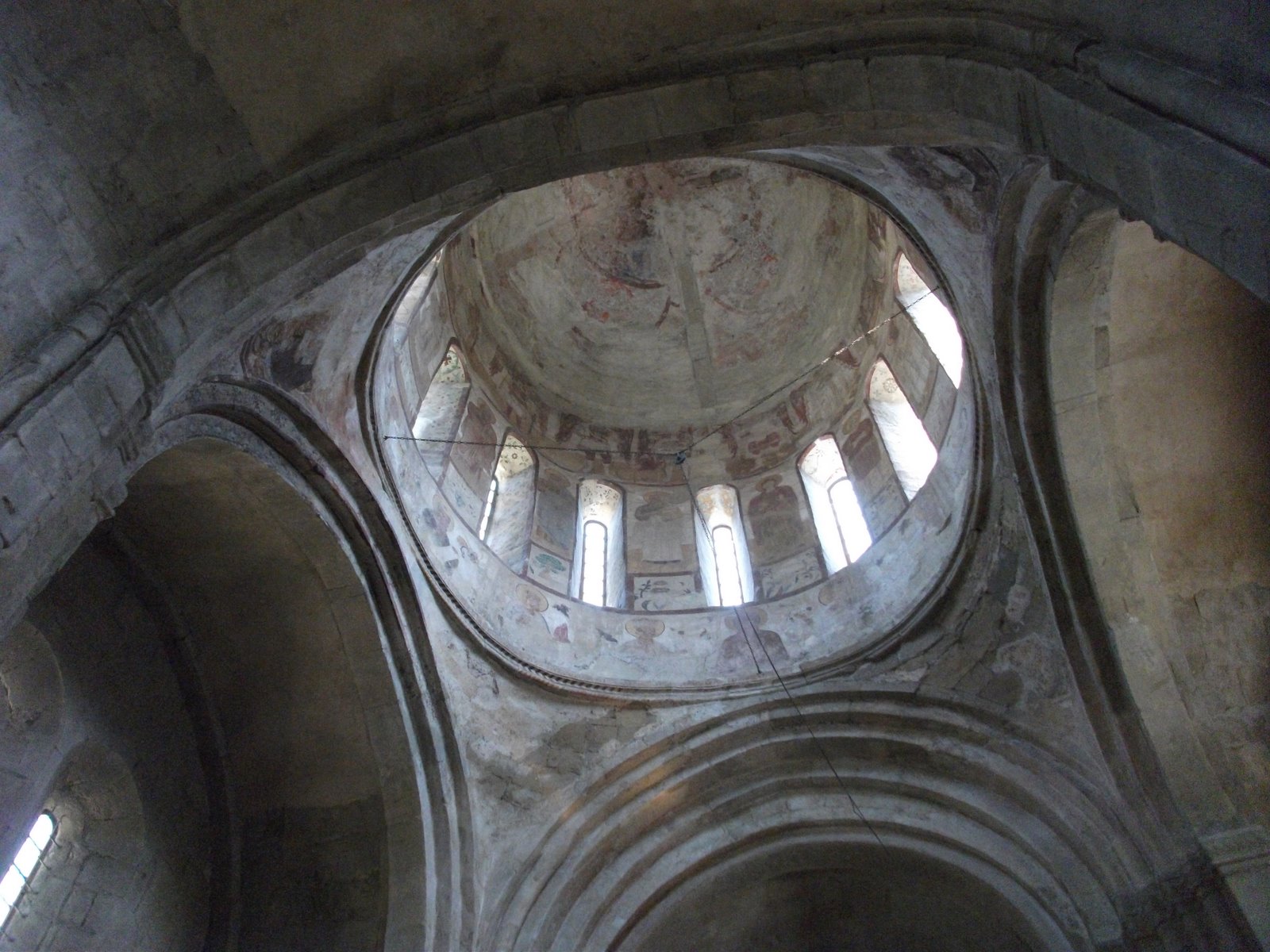
Inside its impressive walls, I done a scarf and we cross the sweltering plaza, enter the massive doors and find ourselves in a towering space, cool; shadowy and mysterious.
Candles flicker, the smell of burning incense is strong. Brass and gold shine below walls of enormous frescoes.
Women swathed in scarves and huge aprons bend nearly double over hand-cobbled brush brooms, a continuous sweeping, sweeping, sweeping that did not stop while we were there. I find myself wondering if they might not be the prototype for the Soviet BabaYaga, the witch with the broom and the house that turns on chicken legs.
Inside the massive space sits another stone cathedral,
perfect in proportion and detail, a miniature of the great cathedral that encases it. It is the site, where in 327 the first convert, Georgian Queen Nana, converted to Christianity.
Near it, the iconic glass and gold tomb of the Queen herself. I take pictures and again get in trouble – an old man in hat, boots and slavic-looking belted shirt, praying at the miniature cathedral believes that I have taken his picture. I haven't, but back off out of respect.
Svetitskhoveli is our introduction to the history of Georgia. Here we learned the connection between St Nino and Saint George and the Dragon....
I was sheepish. “I've been busy. You know... marketing work. My book. I'm being workshopped at Lighthouse Writers Workshop. Revisions....page goals.....gee, you mean people are really paying attention?”
He assured me, people are. ”Well, life got complicated,” I told him apologetically.”Sometimes it feels as if adventure is far away from me. Must have been another person who was there. Not me”
“You made that trip for all of us,” he said. ”Write!”
So again...I am there.
Inside its impressive walls, I done a scarf and we cross the sweltering plaza, enter the massive doors and find ourselves in a towering space, cool; shadowy and mysterious.
Candles flicker, the smell of burning incense is strong. Brass and gold shine below walls of enormous frescoes.
Women swathed in scarves and huge aprons bend nearly double over hand-cobbled brush brooms, a continuous sweeping, sweeping, sweeping that did not stop while we were there. I find myself wondering if they might not be the prototype for the Soviet BabaYaga, the witch with the broom and the house that turns on chicken legs.
Inside the massive space sits another stone cathedral,
perfect in proportion and detail, a miniature of the great cathedral that encases it. It is the site, where in 327 the first convert, Georgian Queen Nana, converted to Christianity.
Near it, the iconic glass and gold tomb of the Queen herself. I take pictures and again get in trouble – an old man in hat, boots and slavic-looking belted shirt, praying at the miniature cathedral believes that I have taken his picture. I haven't, but back off out of respect.
Svetitskhoveli is our introduction to the history of Georgia. Here we learned the connection between St Nino and Saint George and the Dragon....
Wednesday, January 5, 2011
From Tbilisi to Mtskheta
Some days of our lives remain – fixed points of reference for all that was before and all that comes after. Our first day in Georgia was such a day....
We can see no fewer than 12 ancient churches from our windows and balcony, plus the modern national cathedral and the president's house. We are located in Old Tbilisi, just uphill from the ancient sulfur baths/banyas. (which will play a big role in activities in a day or two.....) Tbilisi seems a city caught between not just cultures, but centuries. Streets of rubble outside the apartment enclosure gate lead, in only a few blocks, to gorgeous inlaid pavement.
Still in the clothes in which we arrived (luggage lost, you'll recall) and with aching heads not yet in that timezone, we follow Nic through the streets, over a bridge, down another road, down, down down into the deep Soviet era subway. We emerge somewhere distant, and wend our way back out of the subterranean walkways, where impoverished people peddle the ubiquitous wheels and wedges of the salty, Georgian stinky cheese (non-refrigerated), cheap toys, old clothes and heartbreakingly, their family heirlooms. There is no time to stop, as Nic pushes on, having warned us about the Gypsy children sent out in droves to beg. “Give them food, they can eat it,” he advises. “Give them money, they will never see it.”
We break out into the sunlight, near blinded and wend through a bustling open-air market overflowing with bananas, watermelons, tomatoes, cucumbers, onions and garlics and many fruits and vegetables I haven't a clue as to their pedigree.
The bins and pull carts, barrels and boxes follow somewhat orderly lines, but everywhere there are vans in every spare space and people hurrying this way and that, or talking with men standing at the vans. Negotiating, we learn for their destinations and fares. They are the marshrutka of Nic's research (Russian Analytical Digest, Dec. 2010) vans that take people, mail, packages and news from place to palce throughout most of the former Soviet countries.
Nic negotiates. We stuff ourselves into a back seat and we are off, bouncing over rutted roads, stopping to drop off people and pick up packages. There is no air conditioning in the late July heat. Nic points out the American Embassy and the road from the airport we traveled in the early morning hours.
We are on our way to Mtskheta, a village outside Tbilisi in which stands Svetitskhoveli, site of the first Christian conversion in Georgia and for hundreds of years, designated the “Mother Church,” and National Cathedral, before that title was bestowed an a brand new cathedral in Tbilisi.
Once there we enter the massive building.....
We can see no fewer than 12 ancient churches from our windows and balcony, plus the modern national cathedral and the president's house. We are located in Old Tbilisi, just uphill from the ancient sulfur baths/banyas. (which will play a big role in activities in a day or two.....) Tbilisi seems a city caught between not just cultures, but centuries. Streets of rubble outside the apartment enclosure gate lead, in only a few blocks, to gorgeous inlaid pavement.
Still in the clothes in which we arrived (luggage lost, you'll recall) and with aching heads not yet in that timezone, we follow Nic through the streets, over a bridge, down another road, down, down down into the deep Soviet era subway. We emerge somewhere distant, and wend our way back out of the subterranean walkways, where impoverished people peddle the ubiquitous wheels and wedges of the salty, Georgian stinky cheese (non-refrigerated), cheap toys, old clothes and heartbreakingly, their family heirlooms. There is no time to stop, as Nic pushes on, having warned us about the Gypsy children sent out in droves to beg. “Give them food, they can eat it,” he advises. “Give them money, they will never see it.”
We break out into the sunlight, near blinded and wend through a bustling open-air market overflowing with bananas, watermelons, tomatoes, cucumbers, onions and garlics and many fruits and vegetables I haven't a clue as to their pedigree.
The bins and pull carts, barrels and boxes follow somewhat orderly lines, but everywhere there are vans in every spare space and people hurrying this way and that, or talking with men standing at the vans. Negotiating, we learn for their destinations and fares. They are the marshrutka of Nic's research (Russian Analytical Digest, Dec. 2010) vans that take people, mail, packages and news from place to palce throughout most of the former Soviet countries.
Nic negotiates. We stuff ourselves into a back seat and we are off, bouncing over rutted roads, stopping to drop off people and pick up packages. There is no air conditioning in the late July heat. Nic points out the American Embassy and the road from the airport we traveled in the early morning hours.
We are on our way to Mtskheta, a village outside Tbilisi in which stands Svetitskhoveli, site of the first Christian conversion in Georgia and for hundreds of years, designated the “Mother Church,” and National Cathedral, before that title was bestowed an a brand new cathedral in Tbilisi.
Once there we enter the massive building.....
Labels:
Caucasus,
Mountains,
Republic of Georgia,
Tbilisi
Friday, December 31, 2010
The Memory Keepers
I am a memory-keeper. Are you?
I pause in our adventures in the Republic of Georgia to reflect on the great truth of time. Next week is soon enough to get back to the telling of the tale. Time ran away with me these past few weeks; perhaps it did with you as well. It was filled with holiday songs and Christmas videos, holiday baking and our Wondra traditional meals. Our Christmas cards got mailed after Xmas and this week I finally got calls made to family and dear friends who were on my heart and far away.
Here's what I think. Time counts when the events of time and place are recorded, retold, passed down from person to person, generation to generation. Time counts when the adventures, the lessons learned, the tragedies and good deeds done are recounted. Perhaps we, like that old velveteen rabbit, are made real by the people who love us. But I believe that we remain real when the sound of our voices and the stories of our lives echo through the ages. This I know because the holidays always bring me closer to the stories of my family – the Swedish and Norwegian farmer and woodsman immigrants, the German merchants...and most recently I have learned of the entire Fleming branch that dates to pre-revolutionary war days. Who would have thought?
Days like today remind me that all we really have is today. Yesterday – all the yesterdays – may come back to you as wonderful memories, but they are gone. We don't get the moments and days back. Tomorrow? Well, none of us knows if we are going to be given another day, let alone another year.
We await the arrive back home of Nic and Sora next week, after their sixteen months abroad. At the rate I'm sharing our adventure with you, they will be back before I finish. But the adventure is committed to words. The memory lives on. My role as memory-keeper of past days and our days, is secure. It awaits others to carry it on down through time.
Happy New Year!
I pause in our adventures in the Republic of Georgia to reflect on the great truth of time. Next week is soon enough to get back to the telling of the tale. Time ran away with me these past few weeks; perhaps it did with you as well. It was filled with holiday songs and Christmas videos, holiday baking and our Wondra traditional meals. Our Christmas cards got mailed after Xmas and this week I finally got calls made to family and dear friends who were on my heart and far away.
Here's what I think. Time counts when the events of time and place are recorded, retold, passed down from person to person, generation to generation. Time counts when the adventures, the lessons learned, the tragedies and good deeds done are recounted. Perhaps we, like that old velveteen rabbit, are made real by the people who love us. But I believe that we remain real when the sound of our voices and the stories of our lives echo through the ages. This I know because the holidays always bring me closer to the stories of my family – the Swedish and Norwegian farmer and woodsman immigrants, the German merchants...and most recently I have learned of the entire Fleming branch that dates to pre-revolutionary war days. Who would have thought?
Days like today remind me that all we really have is today. Yesterday – all the yesterdays – may come back to you as wonderful memories, but they are gone. We don't get the moments and days back. Tomorrow? Well, none of us knows if we are going to be given another day, let alone another year.
We await the arrive back home of Nic and Sora next week, after their sixteen months abroad. At the rate I'm sharing our adventure with you, they will be back before I finish. But the adventure is committed to words. The memory lives on. My role as memory-keeper of past days and our days, is secure. It awaits others to carry it on down through time.
Happy New Year!
Wednesday, December 8, 2010
Back in Tbilisi Again
Our first views of Tbilisi were in the darkness before dawn, in the back seat of a taxi speeding through a sleeping city. Nic and our driver, pointed out gorgeously-lit public buildings. “Look there! Parliament!
“There – The Sheraton where the revolt took place. It's been repaired.”
“Over there – the Opera House!”
Above everything, high on the hills surrounding the city, the lights of the Georgian TV station and the fortress, Narikala – both bathed in sentinel lights.
It is, we learn, the view from the bedroom window of the apartment as well. In fact, Nartikala is the view from the kitchen window and the apartment balcony as well. The fortress and its fortifications date from the 4th to 17th centuries. At any time of the day it looms large – especially so over Old Town Tbilisi where Nic and Sora live. Tbilisi has many symbols and this is one of the most important.
In reality, we spent most of our days while in Georgia in Tbilisi itself, by turns gracious, grubby, grappling city coming to terms with it's past,it's present and its future all at once.
Tbilisi is a meeting ground, stomping place, rolled-over conquered, conquering, sophisticated, crude, hopeful, fatalistic, tradition-bound, welcoming, cautious contradiction. Here east meets west meets middle-east. Largely over looked by the world, Georgia and its people survived communism only to struggle with democracy, embrace most things west while rattling sabers at our old cold-war nemesis; Russia.
My great apologies for leaving you in Khaketi, on the Grape Road in the middle of a funeral procession for so long! It was a dark place to abandon my readers, but my router died and with it access to my laptop treasure-trove of pictures. (Now that I have conquered the picture-posting thing it seemed a shame to attempt painting only word pictures of our adventure.)
We spent only that one day on the Grape Road, although for some readers it may seem longer. But without that day, I wonder if I could have begin to grasp the spirit of the Georgian people and the shift occurring in this place. It is not just a tug-of-war between east, west and Middle East. it is a struggle to shed the last vestiges of Soviet era machinery and a stumbling, bumbling dash from the past into the 21st century.
It is still dark when we arrive, dragging the one bag that has stayed with us into a dirt courtyard, around cars bedded down for the night and up steep curving stairs to the apartment. After thirty two hours of travel, sleep and wake are at war and for a few hours, sleep wins.
When the sun comes up.......
“There – The Sheraton where the revolt took place. It's been repaired.”
“Over there – the Opera House!”
Above everything, high on the hills surrounding the city, the lights of the Georgian TV station and the fortress, Narikala – both bathed in sentinel lights.
It is, we learn, the view from the bedroom window of the apartment as well. In fact, Nartikala is the view from the kitchen window and the apartment balcony as well. The fortress and its fortifications date from the 4th to 17th centuries. At any time of the day it looms large – especially so over Old Town Tbilisi where Nic and Sora live. Tbilisi has many symbols and this is one of the most important.
In reality, we spent most of our days while in Georgia in Tbilisi itself, by turns gracious, grubby, grappling city coming to terms with it's past,it's present and its future all at once.
Tbilisi is a meeting ground, stomping place, rolled-over conquered, conquering, sophisticated, crude, hopeful, fatalistic, tradition-bound, welcoming, cautious contradiction. Here east meets west meets middle-east. Largely over looked by the world, Georgia and its people survived communism only to struggle with democracy, embrace most things west while rattling sabers at our old cold-war nemesis; Russia.
My great apologies for leaving you in Khaketi, on the Grape Road in the middle of a funeral procession for so long! It was a dark place to abandon my readers, but my router died and with it access to my laptop treasure-trove of pictures. (Now that I have conquered the picture-posting thing it seemed a shame to attempt painting only word pictures of our adventure.)
We spent only that one day on the Grape Road, although for some readers it may seem longer. But without that day, I wonder if I could have begin to grasp the spirit of the Georgian people and the shift occurring in this place. It is not just a tug-of-war between east, west and Middle East. it is a struggle to shed the last vestiges of Soviet era machinery and a stumbling, bumbling dash from the past into the 21st century.
It is still dark when we arrive, dragging the one bag that has stayed with us into a dirt courtyard, around cars bedded down for the night and up steep curving stairs to the apartment. After thirty two hours of travel, sleep and wake are at war and for a few hours, sleep wins.
When the sun comes up.......
Labels:
Caucasus,
Mountains,
Republic of Georgia,
Tbilisi
Thursday, November 11, 2010
Life and Death in Georgia
The procession came from the left, up the incline to the paved road from a cluster of tumbled-together village homes. Nic was up front of the car, bargaining for strings of garlic and onions with several elderly villagers at a makeshift stand, when it appeared.
As we watch from the car, six men and boys in plaid shirts, carrying an open pine box on their shoulders led the way. Just as they met the paved road, the front man on the near side slipped in the loose dirt, momentarily unbalancing the open casket on their shoulders. The casket lurched, giving us a sideways impression of an elderly face in repose, looking decidedly green-black. He recovered and the procession moved on, across the road and down the far side. It was followed by a straggling procession of women, girls a few men and young children in black, carrying all manner of colorful umbrellas against the afternoon heat. No one looked especially sad.
“Now there's something you don't see every day,” I remarked.
“No,” agreed Sora and was silent a moment. “And not only do they don't embalm here, they still lay the deceased out at home," she added. "Then they summon the family and friends to morn. It can take a week or two for everyone to arrive before they hold the funeral.”
We considered the weight of that information in silence. The heat of the August day there in the car is stifling. It's August. I try not to imagine the smell.
Nic returned from his successful produce negotiations at the village stand.“She was ninety two,” he announced, cheerfully, as our driver pulls out and proceeds slowly down the road and past the casket, being loaded into an ancient hearse. “She was the village matriarch. They said she had a good, long life.”
I set to imagining a matriarch who drank some good Georgian wine every day of her long, adult life, who will return to the earth to nurture her grape vines. While the aesthetics of American life don't encourage most of us to think about death in this fashion, it may be good to recall that dealing with death in this way is quite ecological. Quite green, in fact (no pun intended). In the United states, a slowly growing trend toward green funerals is making a comeback, as a biodegradable reaction to the environmental impact of embalming chemicals, as well as a return to the natural cycle of life.
I'm not sure it will really catch on here. But such is life, and death, in Georgia.
As we watch from the car, six men and boys in plaid shirts, carrying an open pine box on their shoulders led the way. Just as they met the paved road, the front man on the near side slipped in the loose dirt, momentarily unbalancing the open casket on their shoulders. The casket lurched, giving us a sideways impression of an elderly face in repose, looking decidedly green-black. He recovered and the procession moved on, across the road and down the far side. It was followed by a straggling procession of women, girls a few men and young children in black, carrying all manner of colorful umbrellas against the afternoon heat. No one looked especially sad.
“Now there's something you don't see every day,” I remarked.
“No,” agreed Sora and was silent a moment. “And not only do they don't embalm here, they still lay the deceased out at home," she added. "Then they summon the family and friends to morn. It can take a week or two for everyone to arrive before they hold the funeral.”
We considered the weight of that information in silence. The heat of the August day there in the car is stifling. It's August. I try not to imagine the smell.
Nic returned from his successful produce negotiations at the village stand.“She was ninety two,” he announced, cheerfully, as our driver pulls out and proceeds slowly down the road and past the casket, being loaded into an ancient hearse. “She was the village matriarch. They said she had a good, long life.”
I set to imagining a matriarch who drank some good Georgian wine every day of her long, adult life, who will return to the earth to nurture her grape vines. While the aesthetics of American life don't encourage most of us to think about death in this fashion, it may be good to recall that dealing with death in this way is quite ecological. Quite green, in fact (no pun intended). In the United states, a slowly growing trend toward green funerals is making a comeback, as a biodegradable reaction to the environmental impact of embalming chemicals, as well as a return to the natural cycle of life.
I'm not sure it will really catch on here. But such is life, and death, in Georgia.
Labels:
Caucasus,
Mountains,
Republic of Georgia,
Tbilisi
Friday, November 5, 2010
The Real Bounty of Georgia
Nic begins negotiations with the matrons for buckets of peaches as the rest of us attempt to stay in the shade along the two-lane paved road..
Trucks, ancient cars, fancy new sport utility vehicles and donkey driven wooden carts loaded with hay, boxes of produce or barrels of something, pass us in both directions. The sport utility vehicles careen around the carts, defying the obvious dimensions of the road width. Looking about, I realize we are not so much in a village, as stopped at a cluster of buildings; probably an extended-family compound. Fields and vineyards stretch out around us, fences lean crazily bordering narrow, dirt lanes. The building materials are varied and ingenious – cobbled together from stone, concrete, wattle, plaster – whatever building materials were available. These people use what they have to create sanctuary.
One of the women trots across the narrow, busy road to the trunk of an ancient Soviet-era car and selecting from this or that box in the trunk, loads another bushel. She hurries back across the road, apparently telling Nic that these have been hand-selected for us.
I pull out my camera to get pictures of the negotiations. Seeing the camera, the matrons are thrilled to pose with Nic and Sora – the Americans who speak Russian. They smooth their aprons, pull off their head scarves, some lower their heads shyly, peaking up coyly toward the camera. A couple of them just downright blush. I suspect that, in their lives, there haven't been many pictures taken of these kindly matrons.
An excited conversation follows in Russian between Nic and the matrons. Suddenly, one matron turns and runs off down the shady lane at a dead run. I have no idea of her age, but she would have done justice to a high school sprinter.
“What,”we wonder “is going on?”
“They want copies of the pictures,” says Sora, as Nic scribbles something into a tiny pocket notebook. “And she has gone to get the family wine.”
The family wine! So we net not just peaches – but some of that special Georgian amber wine!
Nic pays for the peaches and we get them loaded in the back of the car. Back up the lane runs the matron, waving a plastic soda bottle of the family vintage in one hand and holding in her other hand the strange, bumpy, white-coated cords of churchkhela, the sweet, chewy, Georgian delicacy. Since the grape harvest is just beginning and making these, Sora tells us, takes many steps of dipping, drying and then rolling in sugar, we assume that they are the last of the previous season. And the wine, we learn, will have come from the huge, clay kvevris, or wine amphoras dug right into the ground for aging the family vintage.
Panting from her sprint, but beaming from ear to ear, the matron thrusts the precious gifts into Nic's hands and stands back. Her shoulders straighten and with dignity, she smooths her apron. Everyone nods and bows and smiles. We have been honored with the legendary Georgian hospitality!
I suddenly “get” that the real richness of Georgia is not just it's bounty, but the hospitality of its people. Their very traditions are rich, generous, accommodating. This is a people that appreciates the bounty of the earth, and the spirit of generosity that feeds both stomachs and spirits. Long-suffering, and as we are to learn, often frightfully ignorant of the humanity of their neighbors, they possessing an understanding of the basic human connection...the thread that links all of us is life itself, love and family. That thread is what drew us to Georgia.
It is a thread that links this place and this time to my own upbringing on a Wisconsin dairy farm. Just such hospitality was offered to guests at the modest family farm. I feel a sudden fullness in my chest and tears gather behind my eyes. The image of my Mother, proffering her homemade buns, just-made jams and jellies, still-warm cookies and steaming hot Norwegian coffee to friends and strangers alike in her country dining room, join the images of this Georgian country road. I swallow hard.
Back into the car we pile. Within a few miles we have stopped for watermelons, peaches, then again for tomatoes, and finally for strings of onions and garlic. At that point another pure Georgian experience awaits us.....
Trucks, ancient cars, fancy new sport utility vehicles and donkey driven wooden carts loaded with hay, boxes of produce or barrels of something, pass us in both directions. The sport utility vehicles careen around the carts, defying the obvious dimensions of the road width. Looking about, I realize we are not so much in a village, as stopped at a cluster of buildings; probably an extended-family compound. Fields and vineyards stretch out around us, fences lean crazily bordering narrow, dirt lanes. The building materials are varied and ingenious – cobbled together from stone, concrete, wattle, plaster – whatever building materials were available. These people use what they have to create sanctuary.
One of the women trots across the narrow, busy road to the trunk of an ancient Soviet-era car and selecting from this or that box in the trunk, loads another bushel. She hurries back across the road, apparently telling Nic that these have been hand-selected for us.
I pull out my camera to get pictures of the negotiations. Seeing the camera, the matrons are thrilled to pose with Nic and Sora – the Americans who speak Russian. They smooth their aprons, pull off their head scarves, some lower their heads shyly, peaking up coyly toward the camera. A couple of them just downright blush. I suspect that, in their lives, there haven't been many pictures taken of these kindly matrons.
An excited conversation follows in Russian between Nic and the matrons. Suddenly, one matron turns and runs off down the shady lane at a dead run. I have no idea of her age, but she would have done justice to a high school sprinter.
“What,”we wonder “is going on?”
“They want copies of the pictures,” says Sora, as Nic scribbles something into a tiny pocket notebook. “And she has gone to get the family wine.”
The family wine! So we net not just peaches – but some of that special Georgian amber wine!
Nic pays for the peaches and we get them loaded in the back of the car. Back up the lane runs the matron, waving a plastic soda bottle of the family vintage in one hand and holding in her other hand the strange, bumpy, white-coated cords of churchkhela, the sweet, chewy, Georgian delicacy. Since the grape harvest is just beginning and making these, Sora tells us, takes many steps of dipping, drying and then rolling in sugar, we assume that they are the last of the previous season. And the wine, we learn, will have come from the huge, clay kvevris, or wine amphoras dug right into the ground for aging the family vintage.
Panting from her sprint, but beaming from ear to ear, the matron thrusts the precious gifts into Nic's hands and stands back. Her shoulders straighten and with dignity, she smooths her apron. Everyone nods and bows and smiles. We have been honored with the legendary Georgian hospitality!
I suddenly “get” that the real richness of Georgia is not just it's bounty, but the hospitality of its people. Their very traditions are rich, generous, accommodating. This is a people that appreciates the bounty of the earth, and the spirit of generosity that feeds both stomachs and spirits. Long-suffering, and as we are to learn, often frightfully ignorant of the humanity of their neighbors, they possessing an understanding of the basic human connection...the thread that links all of us is life itself, love and family. That thread is what drew us to Georgia.
It is a thread that links this place and this time to my own upbringing on a Wisconsin dairy farm. Just such hospitality was offered to guests at the modest family farm. I feel a sudden fullness in my chest and tears gather behind my eyes. The image of my Mother, proffering her homemade buns, just-made jams and jellies, still-warm cookies and steaming hot Norwegian coffee to friends and strangers alike in her country dining room, join the images of this Georgian country road. I swallow hard.
Back into the car we pile. Within a few miles we have stopped for watermelons, peaches, then again for tomatoes, and finally for strings of onions and garlic. At that point another pure Georgian experience awaits us.....
Labels:
Caucasus,
Mountains,
Republic of Georgia,
Tbilisi
Tuesday, October 19, 2010
Some Seasons are Meant to Celebrate
Georgia is beautiful; a strange mix of wild spaces and barely-tamed places.
Its striking mountains, carefully-cultivated vineyards mesh into identity-challenged fields of hay with sunflowers sprouting about, and unfettered cattle roaming the roadsides. (Combine that with Georgian speeding vehicles and you've got steak tartar -- on the hoof.) The land under cultivation is both hard-won and generous. “Georgians,” Nic says, “say that just about anything will grow here, if you just drop it on the ground.”
I have visions of the the Narnian lamp post falling from the sky and taking root here, not as a lone sentinel, but becoming a forest of gas lights!
Our pace on the return is interspersed with produce negotiations.
The third truth of Kakheti is that when produce comes into season – it is time to celebrate the harvest! The roadsides are lined with families selling watermelons from the trunks of their cars. The sun is merciless. Town elders in long-sleeve shirts perch on wooden benches and crude hand-made chairs, holding umbrellas or squinting beneath make-shift sun shades, next to crates of cucumbers, tomatoes, beans, onions, garlics, leeks, peppers, corn, squash.
Women, dresses mostly in black, fan themselves next to boxes of strawberries, buckets of peaches, heaps of the first grapes and "churchkhela," the Georgian confection created by threading the nuts on long strings,dipping them repeatedly in concentrated grape juice, then rolled in confectionary sugar and hung to dry.
The result looks a lot like a bumpy stick of licorice or a skinny stick of sausage and is said to contain enough concentrated energy that they were carried on military campaigns. (It must be the original energy bar!)
Sadly, we are too early to attend the traditional, autumn rtveli (wine harvest). The Kakheti wine processing is like no other in the world – labor-intensive and quite different than European practices. After pressing, the grapes, the juices, skins, stems and seeds are all fermented together, yielding a wine that is raisin y, and Madeira-like, with a clear, amber hue. The method is dying out in the region's commercial vineyards, but the family plots and family vintages continue in the traditional way.
A fortuitous stop in a tiny village – well actually it was a few buildings and a lane running back from the highway—proved fruitful. At that juncture stood four village matrons surrounded by buckets of peaches. “Peaches!” Nic exclaimed from his interpreter's seat beside our driver. “Pull over!”
(or at least that's what I assume he said, since he spoke it in Russian.)
The driver braked and careened to the side of the road and out we piled.
Its striking mountains, carefully-cultivated vineyards mesh into identity-challenged fields of hay with sunflowers sprouting about, and unfettered cattle roaming the roadsides. (Combine that with Georgian speeding vehicles and you've got steak tartar -- on the hoof.) The land under cultivation is both hard-won and generous. “Georgians,” Nic says, “say that just about anything will grow here, if you just drop it on the ground.”
I have visions of the the Narnian lamp post falling from the sky and taking root here, not as a lone sentinel, but becoming a forest of gas lights!
Our pace on the return is interspersed with produce negotiations.
The third truth of Kakheti is that when produce comes into season – it is time to celebrate the harvest! The roadsides are lined with families selling watermelons from the trunks of their cars. The sun is merciless. Town elders in long-sleeve shirts perch on wooden benches and crude hand-made chairs, holding umbrellas or squinting beneath make-shift sun shades, next to crates of cucumbers, tomatoes, beans, onions, garlics, leeks, peppers, corn, squash.
Women, dresses mostly in black, fan themselves next to boxes of strawberries, buckets of peaches, heaps of the first grapes and "churchkhela," the Georgian confection created by threading the nuts on long strings,dipping them repeatedly in concentrated grape juice, then rolled in confectionary sugar and hung to dry.
The result looks a lot like a bumpy stick of licorice or a skinny stick of sausage and is said to contain enough concentrated energy that they were carried on military campaigns. (It must be the original energy bar!)
Sadly, we are too early to attend the traditional, autumn rtveli (wine harvest). The Kakheti wine processing is like no other in the world – labor-intensive and quite different than European practices. After pressing, the grapes, the juices, skins, stems and seeds are all fermented together, yielding a wine that is raisin y, and Madeira-like, with a clear, amber hue. The method is dying out in the region's commercial vineyards, but the family plots and family vintages continue in the traditional way.
A fortuitous stop in a tiny village – well actually it was a few buildings and a lane running back from the highway—proved fruitful. At that juncture stood four village matrons surrounded by buckets of peaches. “Peaches!” Nic exclaimed from his interpreter's seat beside our driver. “Pull over!”
(or at least that's what I assume he said, since he spoke it in Russian.)
The driver braked and careened to the side of the road and out we piled.
Tuesday, October 5, 2010
The Georgian Truth: Life is short – celebrate!
There are days that seem to slow down, whose meaning is apparent, when the value of this short life is measured as priceless.
Between the heat and my jet lag, I loose track of whether this is one of them or not and only later discover the truth; that all experiences enrich one, if your soul allows access.
The day's un-relenting heat and humidity makes the air shimmer. We are off the main road, following the fence lines deep in Kakheti and our pace is nearly sane. The grape vineyards appear lush. Taking in their endless reach toward the towering Caucasus in the distance, I recall hearing stories of this land's creation.
Georgian's have lived in their land for millennia. Cities like Batumi, along the Black Sea, were occupied long before the Greeks and Romans named the settlements. Georgians have two stories about how they came to live in the land that they call the most beautiful place on earth. Both are intimately tied with the bounty of the land and the unique spirit of this people.
The first story is completely in Georgian character: It seems that while God was busy assigning countries to the peoples of the world, everyone else showed up to get their assignments. Not the Georgians. While this was going on, they were busy having a party. Food and wine were flowing. Joyous dancing and song celebrated life and love. Toast after toast was made and, you guessed it, the Georgians missed their assignment. God finished His work and saved the best land of all for Himself; the bounteous land of Georgia. There, He discovered the Georgians, feasting and celebrating life and toasting God for the abundance they had received; unconcerned about possessing what they saw as God's creation. God was pleased that they recognized the source of the bounty and rewarded them with the garden that He had saved for himself.
Another version says that God was assigning the bounty of the world to the people in it and tripped over the Caucasus mountains, spilling into the lush garden land of Georgia all good and growing things. Seeing that the people cared for it well, he gave the land to the Georgians.
Take your pick.
The Turks, the Tartars, the Mongols, the Nazis and the Russians, among others, haven't always agreed with God. Over the centuries no less than forty invasions and protectorates have tromped over and through this land.
As we approach our next destination, the Alaverdi cathedral on the plains of Kakheti, the humidity actually blurs the lines of the cathedral walls marching off in either direction. The snow-covered peaks of the Caucasus appear to rise directly out of the sweltering valley floor, climbing to astonishing heights in surreal back-drop. Hand tools, of the the hand-hewn wood, museum-quality, stand in a row inside the arched and fortified gate. They have been recently used.
We descend the broken steps to the courtyard containing a pampered cathedral vineyard and confront a magnificently-proportioned, classic cathedral surrounding by scaffolding. Proud, ravaged by time and battered by earthquakes, it used to be the largest cathedral in Georgia until the new national cathedral opened in Tbilisi. We stoop to enter a low side door, after discovering that the enormous entrance doors are shrouded in scaffolding.
Upon entering, I get into immediate trouble when I pause to snap a photo. A young,black-robed priest rushes toward me waving his hands, I cannot understand a word, but his meaning is unmistakable. No pictures allowed. I clutch my new digital camera tighter in my hand. If he tries to take it away from me, he is going to end up in a wrestling match!
The ancient frescoes are faint and fractured and in many places, crudely plastered over. Strangely-twisting floor candle holders stand about, most lit. As remote as we are, there are other pilgrims moving about the dim and dusty place, which has clearly seen better days. Here, more so than in the better-preserved churches of Tbilisi, I sense the ancient times and the great faith and fortitude of this people and land.
The cathedral is the far point of our day's destination. Nic fortifies Jeff and Heather with a care package of American comfort food (much of which had arrived in the one bag of ours that actually arrived with us!) before dropping them off and head back north west on The Grape Trail, where more adventures await us.....
Between the heat and my jet lag, I loose track of whether this is one of them or not and only later discover the truth; that all experiences enrich one, if your soul allows access.
The day's un-relenting heat and humidity makes the air shimmer. We are off the main road, following the fence lines deep in Kakheti and our pace is nearly sane. The grape vineyards appear lush. Taking in their endless reach toward the towering Caucasus in the distance, I recall hearing stories of this land's creation.
Georgian's have lived in their land for millennia. Cities like Batumi, along the Black Sea, were occupied long before the Greeks and Romans named the settlements. Georgians have two stories about how they came to live in the land that they call the most beautiful place on earth. Both are intimately tied with the bounty of the land and the unique spirit of this people.
The first story is completely in Georgian character: It seems that while God was busy assigning countries to the peoples of the world, everyone else showed up to get their assignments. Not the Georgians. While this was going on, they were busy having a party. Food and wine were flowing. Joyous dancing and song celebrated life and love. Toast after toast was made and, you guessed it, the Georgians missed their assignment. God finished His work and saved the best land of all for Himself; the bounteous land of Georgia. There, He discovered the Georgians, feasting and celebrating life and toasting God for the abundance they had received; unconcerned about possessing what they saw as God's creation. God was pleased that they recognized the source of the bounty and rewarded them with the garden that He had saved for himself.
Another version says that God was assigning the bounty of the world to the people in it and tripped over the Caucasus mountains, spilling into the lush garden land of Georgia all good and growing things. Seeing that the people cared for it well, he gave the land to the Georgians.
Take your pick.
The Turks, the Tartars, the Mongols, the Nazis and the Russians, among others, haven't always agreed with God. Over the centuries no less than forty invasions and protectorates have tromped over and through this land.
As we approach our next destination, the Alaverdi cathedral on the plains of Kakheti, the humidity actually blurs the lines of the cathedral walls marching off in either direction. The snow-covered peaks of the Caucasus appear to rise directly out of the sweltering valley floor, climbing to astonishing heights in surreal back-drop. Hand tools, of the the hand-hewn wood, museum-quality, stand in a row inside the arched and fortified gate. They have been recently used.
We descend the broken steps to the courtyard containing a pampered cathedral vineyard and confront a magnificently-proportioned, classic cathedral surrounding by scaffolding. Proud, ravaged by time and battered by earthquakes, it used to be the largest cathedral in Georgia until the new national cathedral opened in Tbilisi. We stoop to enter a low side door, after discovering that the enormous entrance doors are shrouded in scaffolding.
Upon entering, I get into immediate trouble when I pause to snap a photo. A young,black-robed priest rushes toward me waving his hands, I cannot understand a word, but his meaning is unmistakable. No pictures allowed. I clutch my new digital camera tighter in my hand. If he tries to take it away from me, he is going to end up in a wrestling match!
The ancient frescoes are faint and fractured and in many places, crudely plastered over. Strangely-twisting floor candle holders stand about, most lit. As remote as we are, there are other pilgrims moving about the dim and dusty place, which has clearly seen better days. Here, more so than in the better-preserved churches of Tbilisi, I sense the ancient times and the great faith and fortitude of this people and land.
The cathedral is the far point of our day's destination. Nic fortifies Jeff and Heather with a care package of American comfort food (much of which had arrived in the one bag of ours that actually arrived with us!) before dropping them off and head back north west on The Grape Trail, where more adventures await us.....
Thursday, September 30, 2010
Along the Grape Road in Kakheti....
The road we are traveling isn't just Marco Polo's historic trade route, although the thought that it is, adds some historic dignity to our madly careening pace. This ancient road is also known as “The Grape Trail.” The Kakheti Region is the center of the wine producing area of Georgia and across the former Soviet Union, Georgia is synonymous with wine.
Unlike Russia, it's neighbor to the north and east, where vodka is the national drink, Georgians love their wine. In fact, the official Kakheti website actually proclaims that every Kakheti family has their own family vineyard. I'm not kidding! The vineyards here have been in production for a few thousand years, Nic tells us. It has been said that the spirit of the Georgian feast resides in its wine (“glvino,” from which descends our modern word “wine”). Just as in Italy, which will be our next country, most vineyards are family plots. Every family makes its own wines here, just as every family has its own pigs for its own bacon, a cow or two to make it's own version of the distinctive, salty Georgian cheese, it's own orchards....Self-sufficient, these people.
Oddly, the vineyards through which we travel appear interspersed with corn fields. It's true, even here, that corn and it's not-all-together-healthy by-products, has become the ubiquitous crop of the world, and is beginning to compete for space with other crops. I find myself rooting for the grape vines and I cannot wait to taste the wine about which I have heard so much!
Sill traveling at breakneck speed, we come out of the deep ravine into the fertile Alazani river plains, having left behind the land with its slow, painfully-pumping oil wells. (which reminded us of the drive between Denver and Longmont, Colorado!) This is a land where vineyards come up to the edges of the road, so close that we can see enormous clusters of grapes hanging heavy on the vines, even at our hysterical speeds. Crumbling, ancient fortresses stand sentinel atop the many distant bluffs. In the distance rise the snow-capped peaks of the Caucasus. Telavi, where we are headed, is the capitol of the wine region and the site of the ancient fortress of the principality of King Irakli II.
Our speeding carriage begins to climb, weaving in and around hay carts and ancient, sputtering trucks loaded with produce. Through tiny village after village, on into the hills above the valley floor we climb. Some are shadowed by sentinel fortresses above them, others still circled by their own rampart remains, reminders of the need for protection from invaders from all sides. For Georgia has had need of protection through the long centuries.
Our pace finally slows as we reach the high point of the plain – the hill city of Telavi. Into the ancient streets we dive, curving around and through the city center, upwards to the castle fortress. We come to a sharp curve and crane our necks looking upwards at the enormous bronze of King Irakli, himself, astride his war horse, then abruptly swing into the parking lot next to the fortress walls, which house castle, chapel, museum and art gallery. Much of the structure dates from the 11-12th centuries, a time when Georgia, like Italy, was divided and ruled by feudal kingdoms. King Irakli presided over what is called “The Golden Era” when Georgia was at its zenith of self-rule.
Inside the wall gates, we stroll through the castle vineyard, pay our fee and begin with the castle, coming face to face with the far east. It is an odd mix of European vaulted and domed-ceilings, combined with Persian, almost Turkish, influence in the key-hole doorways and windows and many wide, covered open-air rooms surrounding the central areas.
The hall ceilings are low (To put it politely, the king was both height-challenged and vain) so passageways and the throne room were designed to make him look taller – the throne room has a dais that placed him above anyone else who entered it.
Strolling past the ruined chapels, we climb to a pergola walk-way with a spectacular view over the entire valley floor to the distant Caucasus peaks. One could imagine twilight hours here with his royal courtesans. Surely the king could spot his enemies coming at a great distance. We catch a breeze and pause, aware that the possibility that the next buildings are air conditioned is remote.
We are right. On that steamy day the art gallery is stifling and dark, containing mediocre European and surprisingly skillful Georgian oil paintings. The museum is cooler and just as dark, full of the requisite ancient armor, even more ancient tools and clay dining utensils, including ancient “chapi,” the two-handled jugs with short necks and bulbous bodies in which Georgian wine has been stored and served for thousands of years. If this sounds biblical, I think they are!
We cool our heels in the rustling shade trees while taking turns at the WCs, which are nothing more than rooms with a hole in the floor and no paper. Jeff and Heather, a Peace Corps couple assigned to the region, join us for the second part of our day. Before leaving Telavi, our driver, with greater care than any he has shown that day, drives us to the great plane tree that graces the center of town. It is over 800 years old, an enormous, long-suffering giant that has withstood invasions, crumbling kingdoms and seemingly, time itself. Plane trees are a symbol of eternal life in Georgia – lore has it that plane trees were THE trees of the garden of Eden. If so, then the tree plays a role in the stories we hear later that day.
We descend again to the valley floor and travel deeper into the countryside...
Unlike Russia, it's neighbor to the north and east, where vodka is the national drink, Georgians love their wine. In fact, the official Kakheti website actually proclaims that every Kakheti family has their own family vineyard. I'm not kidding! The vineyards here have been in production for a few thousand years, Nic tells us. It has been said that the spirit of the Georgian feast resides in its wine (“glvino,” from which descends our modern word “wine”). Just as in Italy, which will be our next country, most vineyards are family plots. Every family makes its own wines here, just as every family has its own pigs for its own bacon, a cow or two to make it's own version of the distinctive, salty Georgian cheese, it's own orchards....Self-sufficient, these people.
Oddly, the vineyards through which we travel appear interspersed with corn fields. It's true, even here, that corn and it's not-all-together-healthy by-products, has become the ubiquitous crop of the world, and is beginning to compete for space with other crops. I find myself rooting for the grape vines and I cannot wait to taste the wine about which I have heard so much!
Sill traveling at breakneck speed, we come out of the deep ravine into the fertile Alazani river plains, having left behind the land with its slow, painfully-pumping oil wells. (which reminded us of the drive between Denver and Longmont, Colorado!) This is a land where vineyards come up to the edges of the road, so close that we can see enormous clusters of grapes hanging heavy on the vines, even at our hysterical speeds. Crumbling, ancient fortresses stand sentinel atop the many distant bluffs. In the distance rise the snow-capped peaks of the Caucasus. Telavi, where we are headed, is the capitol of the wine region and the site of the ancient fortress of the principality of King Irakli II.
Our speeding carriage begins to climb, weaving in and around hay carts and ancient, sputtering trucks loaded with produce. Through tiny village after village, on into the hills above the valley floor we climb. Some are shadowed by sentinel fortresses above them, others still circled by their own rampart remains, reminders of the need for protection from invaders from all sides. For Georgia has had need of protection through the long centuries.
Our pace finally slows as we reach the high point of the plain – the hill city of Telavi. Into the ancient streets we dive, curving around and through the city center, upwards to the castle fortress. We come to a sharp curve and crane our necks looking upwards at the enormous bronze of King Irakli, himself, astride his war horse, then abruptly swing into the parking lot next to the fortress walls, which house castle, chapel, museum and art gallery. Much of the structure dates from the 11-12th centuries, a time when Georgia, like Italy, was divided and ruled by feudal kingdoms. King Irakli presided over what is called “The Golden Era” when Georgia was at its zenith of self-rule.
Inside the wall gates, we stroll through the castle vineyard, pay our fee and begin with the castle, coming face to face with the far east. It is an odd mix of European vaulted and domed-ceilings, combined with Persian, almost Turkish, influence in the key-hole doorways and windows and many wide, covered open-air rooms surrounding the central areas.
The hall ceilings are low (To put it politely, the king was both height-challenged and vain) so passageways and the throne room were designed to make him look taller – the throne room has a dais that placed him above anyone else who entered it.
Strolling past the ruined chapels, we climb to a pergola walk-way with a spectacular view over the entire valley floor to the distant Caucasus peaks. One could imagine twilight hours here with his royal courtesans. Surely the king could spot his enemies coming at a great distance. We catch a breeze and pause, aware that the possibility that the next buildings are air conditioned is remote.
We are right. On that steamy day the art gallery is stifling and dark, containing mediocre European and surprisingly skillful Georgian oil paintings. The museum is cooler and just as dark, full of the requisite ancient armor, even more ancient tools and clay dining utensils, including ancient “chapi,” the two-handled jugs with short necks and bulbous bodies in which Georgian wine has been stored and served for thousands of years. If this sounds biblical, I think they are!
We cool our heels in the rustling shade trees while taking turns at the WCs, which are nothing more than rooms with a hole in the floor and no paper. Jeff and Heather, a Peace Corps couple assigned to the region, join us for the second part of our day. Before leaving Telavi, our driver, with greater care than any he has shown that day, drives us to the great plane tree that graces the center of town. It is over 800 years old, an enormous, long-suffering giant that has withstood invasions, crumbling kingdoms and seemingly, time itself. Plane trees are a symbol of eternal life in Georgia – lore has it that plane trees were THE trees of the garden of Eden. If so, then the tree plays a role in the stories we hear later that day.
We descend again to the valley floor and travel deeper into the countryside...
Tuesday, August 31, 2010
Circadian Rhythms and the Meeting of the Continents.
We were moving easterly, on the old European trade route (the one that Marco Polo and his uncles traveled to reach the far east of Persia, India and China) heading toward the border with Azerbaidzhan and Russia when I finally clicked into the right time zone. Ten hours eastward is one big flippin' leap for the internal clock to make. I had faked it pretty well the day before, with only a few hours of sleep after our middle-of-the-night arrival and a short nap in late afternoon. But finally, I was consolidated all in one place – the Kekheti Region of the Republic of Georgia – and one racing vehicle -- a substantial sport utility vehicle being driven by a crazy Georgian driver.
The moment I opened my eyes and made the transition coincided with our driver's particularly aggressive “bully pass” as he barreled up behind a smaller, slower-moving (translation, more sanely-paced) car, riding his bumper until the car edged, just slightly, to the right. Pulling to the middle of the road straddling the line, we began to pass, while meeting an oncoming truck that edged (barely) to his right. I swear, the door handles of all three cars mingled metals! I closed my eyes again and prayed; repeatedly, during that trip, as it turned out. Now that I am a veteran of the Georgian roads, I can tell you – most of them drive like our driver. (Which, coincidentally is exactly how they drive in Russia too!)
Lest you think that my blog sounds like a fiction story, I must confess that I've taken a vacation. Of weeks, countries, and continents. The adventure spanned two and a half continents, at least. I say “at least” because the Republic of Georgia sits on the Black Sea at the juncture of Europe, Asia and the Middle East. Armenia, to its south claim to be in Europe. Turkey, to its southwest claims middle eastern heritage. Azerbaidzhan professes Asian influence but won't commit and Russia, to the northeast is, well – Russia! Thus the half-of-something thing.
The weeks were hectic leading up to the adventure to visit Nic and Sora, there due to his Fulbright in Tbilisi, Georgia. We knew they would take care of us there. It was for the rest of the adventure we needed the extra flight reservations and train passes and hotel reservations and car rentals and international driver's licenses and road maps and Euro exchange. We trekked through five airports to reach Tbilisi, arriving in the middle of the night to an airport packed with people. That is, we arrived, our checked bags did not. They could not keep up with a travel itinerary through four countries and five airlines (three of them contracted to the two major carriers) in the space of 28 hours.
So our adventure began with the clothes on our backs and a son, grinning ear-to-ear, allowed into the baggage claim/customs area to help us fill out (in Russian) the lost-bag forms for our bags. In the process he spotted his bags, lost when he returned from his Washington DC meetings the week prior, resting five feet from my toes – one of them our daughter's distinctive, Cherry Creek High School swim team bag!
First I clicked into the timezone, then accepted that the international data and voice setup for my Blackberry were not going to cooperate. Other than an hour or so that week, I was cut off from world news, social networks, blogs, email and other time-consuming 21st century lifelines. It was me, my digital camera and my notebook capturing this experience. The brownouts so often experienced in Georgia on steaming summer days further made us appreciate when there was electricity at all. Nic had been right. Yes, we had lived overseas in Germany, and yes, when we lived there it was still, in many ways, an “occupied country.” But it had not been, even then, the adventure that they are having.
So, once again, my note books are full, I am determined to conquer my photo phobia to get some visuals up on my blog(or FaceBook)from the trip, and this is the first of many blogs about the adventures we have had!
The moment I opened my eyes and made the transition coincided with our driver's particularly aggressive “bully pass” as he barreled up behind a smaller, slower-moving (translation, more sanely-paced) car, riding his bumper until the car edged, just slightly, to the right. Pulling to the middle of the road straddling the line, we began to pass, while meeting an oncoming truck that edged (barely) to his right. I swear, the door handles of all three cars mingled metals! I closed my eyes again and prayed; repeatedly, during that trip, as it turned out. Now that I am a veteran of the Georgian roads, I can tell you – most of them drive like our driver. (Which, coincidentally is exactly how they drive in Russia too!)
Lest you think that my blog sounds like a fiction story, I must confess that I've taken a vacation. Of weeks, countries, and continents. The adventure spanned two and a half continents, at least. I say “at least” because the Republic of Georgia sits on the Black Sea at the juncture of Europe, Asia and the Middle East. Armenia, to its south claim to be in Europe. Turkey, to its southwest claims middle eastern heritage. Azerbaidzhan professes Asian influence but won't commit and Russia, to the northeast is, well – Russia! Thus the half-of-something thing.
The weeks were hectic leading up to the adventure to visit Nic and Sora, there due to his Fulbright in Tbilisi, Georgia. We knew they would take care of us there. It was for the rest of the adventure we needed the extra flight reservations and train passes and hotel reservations and car rentals and international driver's licenses and road maps and Euro exchange. We trekked through five airports to reach Tbilisi, arriving in the middle of the night to an airport packed with people. That is, we arrived, our checked bags did not. They could not keep up with a travel itinerary through four countries and five airlines (three of them contracted to the two major carriers) in the space of 28 hours.
So our adventure began with the clothes on our backs and a son, grinning ear-to-ear, allowed into the baggage claim/customs area to help us fill out (in Russian) the lost-bag forms for our bags. In the process he spotted his bags, lost when he returned from his Washington DC meetings the week prior, resting five feet from my toes – one of them our daughter's distinctive, Cherry Creek High School swim team bag!
First I clicked into the timezone, then accepted that the international data and voice setup for my Blackberry were not going to cooperate. Other than an hour or so that week, I was cut off from world news, social networks, blogs, email and other time-consuming 21st century lifelines. It was me, my digital camera and my notebook capturing this experience. The brownouts so often experienced in Georgia on steaming summer days further made us appreciate when there was electricity at all. Nic had been right. Yes, we had lived overseas in Germany, and yes, when we lived there it was still, in many ways, an “occupied country.” But it had not been, even then, the adventure that they are having.
So, once again, my note books are full, I am determined to conquer my photo phobia to get some visuals up on my blog(or FaceBook)from the trip, and this is the first of many blogs about the adventures we have had!
Friday, July 2, 2010
Have we ceased to be good?
It's July second. America is ramping up for its 234th Fourth of July as a free people. The RV's are on the road, the grills are being primed. The boats are on the water and the sparklers are close at hand. After nearly two years of down times and a summer coated in oil, Americans desperately want to celebrate; something. Anything. Immediately. Maybe it's time to remember what we really have and what we are called to be.
The 4th of July is always a day of mixed emotions for me.
A few decades ago (how many I'm not saying) I took a water ski to the head while dropping one to slalom ski. I did it in spectacular fashion, in front of the dock of my uncle's lake home...with my fiance standing on the dock and my entire extended family assembled on the grass overlooking the lake. Lots of blood and several stitches at an emergency room later, I only hazily remember the fireworks. Skip a few more years and the 4th of July was spent on a houseboat up the St. Croix River above Stillwater, Minnesota; lazy days, fireflies and volleyball games with strangers who became friends wherever we anchored the boat.
This day sixteen years ago, Bruce Springsteen's “Born in the USA” had hit the top of the charts and we left on a plane for Russia to bring home our new daughter. We spent the 4th of July touring the Kremlin and that evening I had a conversation with our home host; his first free conversation with a westerner in his entire life. I learned that during the Bay of Pigs (I know, some of you are going to have to look that up!) he was living in Cuba and his father was the Russian Ambassador.
Skip forward to the 4th of July 2002; spent with Mother and my children at the patriotic, small town fireworks in Amery, Wisconsin. Our emotions were still raw from the 9-11 attack, and “Proud to be an American” rang in our hearts and minds. I can still smell the damp grass, and the acid smell of the explosions and feel my joy at being with family again. I remember oohing and awing with the crowd assembled for the quite-good small town display, thinking to myself, “This is as close to the real America as we can get.”
We American's love to celebrate our freedom; beacon of light, hope for the world, and all of that. Quite a few folks believe that freedom is wrapped up in an American flag and guaranteed by a concealed gun barrel. Along with many people I ardently believe in personal freedom. I know it has been paid for by the blood, sweat and tears of hundreds of thousands of Americans who have fought to keep us free. But they did not die so that we could be free to do whatever we darn please; they died so that Americans would be free to fulfill the goodness we all carry within us.
I believe in the responsibility that comes with that freedom. I believe that we are kept free just as much by a free press as by the point of a gun. I believe we have a responsibility to seek the truth, from our candidates, our elected officials and those whose job it is protect the rights of all citizens, not just a few. I believe that capitalism fulfills its potential when we hold corporations accountable, not just to their shareholders, but to their employees and to the communities in which they operate. I believe that with freedom comes the personal responsibility to give back “for my community, my country and my world.” (And that folks, is how the last line of the 4-H pledge ends, as a proud alum, I can still remember the entire thing!)
In perspective, 234 years isn't very long in the history of the world. The next chapter of our history is up to us. As Alexis de Toequeville concluded: “America is great because America is good, and if America ever ceases to be good, America will cease to be great.”
I believe in the goodness in all of us. And now I believe I should get off my 4th of July soapbox and get the brats ready!
The 4th of July is always a day of mixed emotions for me.
A few decades ago (how many I'm not saying) I took a water ski to the head while dropping one to slalom ski. I did it in spectacular fashion, in front of the dock of my uncle's lake home...with my fiance standing on the dock and my entire extended family assembled on the grass overlooking the lake. Lots of blood and several stitches at an emergency room later, I only hazily remember the fireworks. Skip a few more years and the 4th of July was spent on a houseboat up the St. Croix River above Stillwater, Minnesota; lazy days, fireflies and volleyball games with strangers who became friends wherever we anchored the boat.
This day sixteen years ago, Bruce Springsteen's “Born in the USA” had hit the top of the charts and we left on a plane for Russia to bring home our new daughter. We spent the 4th of July touring the Kremlin and that evening I had a conversation with our home host; his first free conversation with a westerner in his entire life. I learned that during the Bay of Pigs (I know, some of you are going to have to look that up!) he was living in Cuba and his father was the Russian Ambassador.
Skip forward to the 4th of July 2002; spent with Mother and my children at the patriotic, small town fireworks in Amery, Wisconsin. Our emotions were still raw from the 9-11 attack, and “Proud to be an American” rang in our hearts and minds. I can still smell the damp grass, and the acid smell of the explosions and feel my joy at being with family again. I remember oohing and awing with the crowd assembled for the quite-good small town display, thinking to myself, “This is as close to the real America as we can get.”
We American's love to celebrate our freedom; beacon of light, hope for the world, and all of that. Quite a few folks believe that freedom is wrapped up in an American flag and guaranteed by a concealed gun barrel. Along with many people I ardently believe in personal freedom. I know it has been paid for by the blood, sweat and tears of hundreds of thousands of Americans who have fought to keep us free. But they did not die so that we could be free to do whatever we darn please; they died so that Americans would be free to fulfill the goodness we all carry within us.
I believe in the responsibility that comes with that freedom. I believe that we are kept free just as much by a free press as by the point of a gun. I believe we have a responsibility to seek the truth, from our candidates, our elected officials and those whose job it is protect the rights of all citizens, not just a few. I believe that capitalism fulfills its potential when we hold corporations accountable, not just to their shareholders, but to their employees and to the communities in which they operate. I believe that with freedom comes the personal responsibility to give back “for my community, my country and my world.” (And that folks, is how the last line of the 4-H pledge ends, as a proud alum, I can still remember the entire thing!)
In perspective, 234 years isn't very long in the history of the world. The next chapter of our history is up to us. As Alexis de Toequeville concluded: “America is great because America is good, and if America ever ceases to be good, America will cease to be great.”
I believe in the goodness in all of us. And now I believe I should get off my 4th of July soapbox and get the brats ready!
Wednesday, June 16, 2010
Light-hearted and Oily-footed
It's been a while.
For many reasons -- and many weeks -- I have been the opposite of light-hearted. I have been in amble company. Frankly, this world has a lot of problems. Millions of people have serious, life-altering employment challenges right now. Hundreds of thousands are facing life-threatening health issues. Our country has a really messy, really enormous, environmental nightmare growing by the day on our shores. My problems, the problems of the ill and the unemployed, the problems in the gulf; have no easy solutions. All we can be assured of, as Churchill solemnly promised the British people at the dawn of World War II, is grinding effort, selfless sacrifice, a long, grueling road to victory. Is that any reason to believe that brighter days are ahead? Is it possible to be “light of heart?”
Winston Churchill thought so. Britain was facing the Nazi war machine almost single-handedly when he made his famous....“blood,toil, tears and sweat” speech . He was resolute and confident in the face of overwhelming odds. At the time he may have had no other reason to see light ahead, except that he chose to believe it. Perhaps this should hearten the millions of pensioners who's retirement accounts are invested in British Petroleum. As angry as millions of us are at BP right now, I hope that the mess is a result of an isolated operational failure and not a systemic cost-cutting policy by a respected company.
How do you deal with your challenges? Do you knuckle under or stand and face them? Are you certain of failure or sure of victory? Do you speak in words of gloom and doom, or pour light, confidence and resoluteness into the crisis es you face?
Consider for a minute – the meaning of light-hearted? Websters defines light hearted as being “free from care, gay, cheerful.” I don't think that that is all there is too it. Just as definitions of other words have morphed in past years, I think of light-hearted as choosing to keep your heart filled with light. In our society, to be seen as “light-hearted” is often a choice not to be taken seriously. Is there a difference between not taking a situation seriously or consciously choosing to be “light-of-heart”?
Thoreau thought so. He said: “Let nothing come between you and the light...”
Perhaps it is precisely that: to understand the dire nature of a situation or a condition and choose to cast your light; confident that effort and fate and possibility, and prayer if you are inclined, will come together; making all things work together for good.
This blog was created to celebrate the light of possibility and hope and to pass it along. So in a strictly literal sense, you could say that every one of these blog entries is light-hearted. But if you read this blog regularly, you know that would be simplistic. You know that may of the posts are about serious things. That I have dealt with grief and loss and surrender; with hopelessness and fear, with change and identity and ultimately, with what it means to live an authentic, light-filled life.
Which brings me to this thought. How to be a soul, a being, who is quite literally – filled with light. Each of us must find our own way. I leave you to ponder Thoreau's question: “With all your science can you tell how it is, and whence it is that light comes into the soul?”
For many reasons -- and many weeks -- I have been the opposite of light-hearted. I have been in amble company. Frankly, this world has a lot of problems. Millions of people have serious, life-altering employment challenges right now. Hundreds of thousands are facing life-threatening health issues. Our country has a really messy, really enormous, environmental nightmare growing by the day on our shores. My problems, the problems of the ill and the unemployed, the problems in the gulf; have no easy solutions. All we can be assured of, as Churchill solemnly promised the British people at the dawn of World War II, is grinding effort, selfless sacrifice, a long, grueling road to victory. Is that any reason to believe that brighter days are ahead? Is it possible to be “light of heart?”
Winston Churchill thought so. Britain was facing the Nazi war machine almost single-handedly when he made his famous....“blood,toil, tears and sweat” speech . He was resolute and confident in the face of overwhelming odds. At the time he may have had no other reason to see light ahead, except that he chose to believe it. Perhaps this should hearten the millions of pensioners who's retirement accounts are invested in British Petroleum. As angry as millions of us are at BP right now, I hope that the mess is a result of an isolated operational failure and not a systemic cost-cutting policy by a respected company.
How do you deal with your challenges? Do you knuckle under or stand and face them? Are you certain of failure or sure of victory? Do you speak in words of gloom and doom, or pour light, confidence and resoluteness into the crisis es you face?
Consider for a minute – the meaning of light-hearted? Websters defines light hearted as being “free from care, gay, cheerful.” I don't think that that is all there is too it. Just as definitions of other words have morphed in past years, I think of light-hearted as choosing to keep your heart filled with light. In our society, to be seen as “light-hearted” is often a choice not to be taken seriously. Is there a difference between not taking a situation seriously or consciously choosing to be “light-of-heart”?
Thoreau thought so. He said: “Let nothing come between you and the light...”
Perhaps it is precisely that: to understand the dire nature of a situation or a condition and choose to cast your light; confident that effort and fate and possibility, and prayer if you are inclined, will come together; making all things work together for good.
This blog was created to celebrate the light of possibility and hope and to pass it along. So in a strictly literal sense, you could say that every one of these blog entries is light-hearted. But if you read this blog regularly, you know that would be simplistic. You know that may of the posts are about serious things. That I have dealt with grief and loss and surrender; with hopelessness and fear, with change and identity and ultimately, with what it means to live an authentic, light-filled life.
Which brings me to this thought. How to be a soul, a being, who is quite literally – filled with light. Each of us must find our own way. I leave you to ponder Thoreau's question: “With all your science can you tell how it is, and whence it is that light comes into the soul?”
Monday, May 17, 2010
Time has a direction. Space doesn't.
For months I've been thinking about this; contemplating the meaning of time and where I fit within it. The initial purpose has been the research for a new book I began over the winter. But I will admit the genesis of this thought process came as I struggled with what to do with the rest of my life and where to do it.
We can never go backward, unless we're in science fiction. And I am beginning to think that we can never go home again either. At least not as the same people we were when we left. Even if home has changed little, we have changed. So even the act of placing ourselves back where we began has the effect of changing the place.
For me personally and many people I know, the time since Easter has been a rough one. For others I don't know personally, this has been a time when the very roots of what love, home and security are supposed to mean were shattered.
Just as we set out for a final trip back to my Mother's Wisconsin place in April, the news hit of the adoptive mother who put her seven-year-old adopted son on a plane and sent him back to Moscow. I don't pretend to know the details nor is this the place to say what I think of her actions. As an adoptive Mother of a now 18-year-old Russian adopte, I wept for the child.
I was swept into the intense international media frenzy surrounding this act because of my position as National Vice Chair of Families for Russian and Ukrainian Adoption. Because I manage our national brand, including our website and communications, I spent days answering media questions and writing the FRUA Position paper about the incident. I helped craft messages to our adoptive parents to advise them on reassuring their children that they would not loose their parents as well; and to their schools, to explain how to help adoptive children struggling to understand it. As the FRUA liaison with the US State Dept., I led development of the FRUA Policy Recommendations incorporated into prepartion for the bilateral talks on inter-country adoption that having been going on in Russia this past week. The work is just beginning and, for me, it is all volunteer.
Through all this I thought about the human rights of that child—and for all of us for that matter--to a secure and loving home. To know that there is a place where we are accepted and loved, able to be who and what we are put on this earth to be. I thought about that between the media calls, as I packed and loaded a U-haul with the things that have come to me from my parents. Things that had been left there because,for a time, we thought that we would be the third generation of my family to live, at least part-time, in that old place. It was built in 1885 as the parsonage of the country church next door. It is not to be.
Not just memories flooded around me as we finally finished emptying the Wisconsin country place. Voices came.
They echo across space and time; my Grandfather, rocking away on the lawn glider telling stories: about riding the rails in the frontier west just after the turn of the last century, picking apples in Washington State orchards, putting up buildings in San Fransciso after the 1906 earthquake.
Echoes of my grandmother returned, rattling her iron pots on the old SouthBend stove in the basement, calling everyone to sit down to eat the Christmas Eve Smörgasbord, all the grand children and aunts and uncles gathered 'round. There is my Father, walking from his beloved little red barn, work gloves in one hand, the other raised in greeting as we pull in after the cross-country journey. And his voice again as we wandered the woods together, “This place gives me peace.”
There are my Mother's gentle words as she sat at the dining room table, pen in hand, recording the day's events on her calendars and writing another of her copious letters to us; “Hello Dear, it's Mother....”
There is the happy laughter of my children and their cousins at seasonal work improving their tree house in “The Wisconsin Tree.”
Time moves forward. Spaces are fixed and not directional. They are places that remind us that we come from a place and eventually must move on to another. The Wisconsin place went on the market last week as a “cute hobby farm with house, barn and 18 acres, partly wooded.”
I left the driveway pulling the U-haul. When one says goodbye, sometimes it really is.
We can never go backward, unless we're in science fiction. And I am beginning to think that we can never go home again either. At least not as the same people we were when we left. Even if home has changed little, we have changed. So even the act of placing ourselves back where we began has the effect of changing the place.
For me personally and many people I know, the time since Easter has been a rough one. For others I don't know personally, this has been a time when the very roots of what love, home and security are supposed to mean were shattered.
Just as we set out for a final trip back to my Mother's Wisconsin place in April, the news hit of the adoptive mother who put her seven-year-old adopted son on a plane and sent him back to Moscow. I don't pretend to know the details nor is this the place to say what I think of her actions. As an adoptive Mother of a now 18-year-old Russian adopte, I wept for the child.
I was swept into the intense international media frenzy surrounding this act because of my position as National Vice Chair of Families for Russian and Ukrainian Adoption. Because I manage our national brand, including our website and communications, I spent days answering media questions and writing the FRUA Position paper about the incident. I helped craft messages to our adoptive parents to advise them on reassuring their children that they would not loose their parents as well; and to their schools, to explain how to help adoptive children struggling to understand it. As the FRUA liaison with the US State Dept., I led development of the FRUA Policy Recommendations incorporated into prepartion for the bilateral talks on inter-country adoption that having been going on in Russia this past week. The work is just beginning and, for me, it is all volunteer.
Through all this I thought about the human rights of that child—and for all of us for that matter--to a secure and loving home. To know that there is a place where we are accepted and loved, able to be who and what we are put on this earth to be. I thought about that between the media calls, as I packed and loaded a U-haul with the things that have come to me from my parents. Things that had been left there because,for a time, we thought that we would be the third generation of my family to live, at least part-time, in that old place. It was built in 1885 as the parsonage of the country church next door. It is not to be.
Not just memories flooded around me as we finally finished emptying the Wisconsin country place. Voices came.
They echo across space and time; my Grandfather, rocking away on the lawn glider telling stories: about riding the rails in the frontier west just after the turn of the last century, picking apples in Washington State orchards, putting up buildings in San Fransciso after the 1906 earthquake.
Echoes of my grandmother returned, rattling her iron pots on the old SouthBend stove in the basement, calling everyone to sit down to eat the Christmas Eve Smörgasbord, all the grand children and aunts and uncles gathered 'round. There is my Father, walking from his beloved little red barn, work gloves in one hand, the other raised in greeting as we pull in after the cross-country journey. And his voice again as we wandered the woods together, “This place gives me peace.”
There are my Mother's gentle words as she sat at the dining room table, pen in hand, recording the day's events on her calendars and writing another of her copious letters to us; “Hello Dear, it's Mother....”
There is the happy laughter of my children and their cousins at seasonal work improving their tree house in “The Wisconsin Tree.”
Time moves forward. Spaces are fixed and not directional. They are places that remind us that we come from a place and eventually must move on to another. The Wisconsin place went on the market last week as a “cute hobby farm with house, barn and 18 acres, partly wooded.”
I left the driveway pulling the U-haul. When one says goodbye, sometimes it really is.
Subscribe to:
Posts (Atom)